



World-Class Businesses Near 52-Week Lows (MA + V)
The global payments duopoly rarely trades at a discount. Here is a deep dive on two of the finest businesses in the world and what the stock analyzer says today.
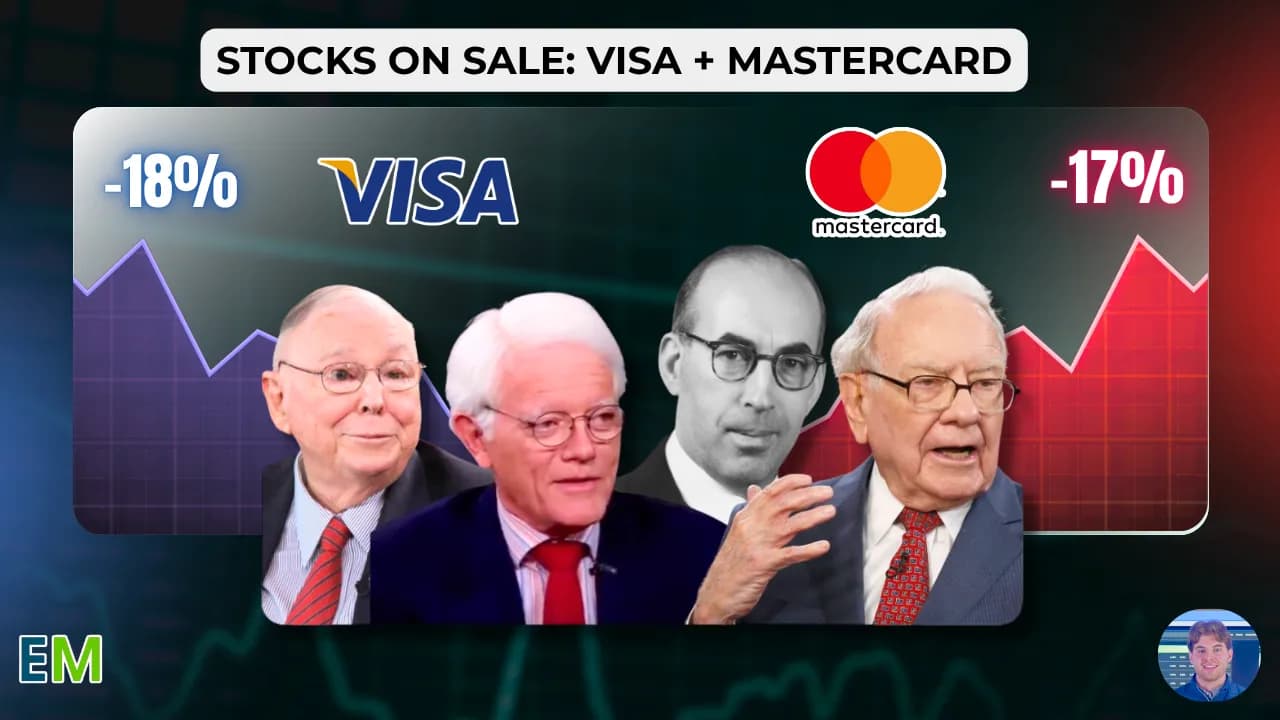
Why 52-Week Lows Matter
There is a reason the 52-week low list makes most investors uncomfortable. Nobody wants to buy something that has been going down. It feels like stepping in front of a moving train. The instinct is to wait until things stabilize, until the news gets better, until the chart looks less scary. But by the time all of that happens, the opportunity is usually gone. The reality is that price and value are two different things. A business does not become worse because its stock is down 20% from a high. In most cases nothing has changed about the underlying earnings power, the competitive position, or the long-term trajectory. What has changed is sentiment — and sentiment is temporary. The gap between a falling price and a growing underlying value is exactly where the opportunity lives.
Warren Buffett has said he gets excited when great businesses go on sale the same way a good shopper gets excited when their favorite store marks things down. That mindset is easy to agree with intellectually and very hard to execute emotionally. That is precisely why our Everything Money software includes both a 52-W Low and Near 52-W Low Screener — to help members cut through the noise and find ideas worth researching when the market is being irrational. Mastercard and Visa are two of the most durable, profitable, and competitively protected businesses on earth. They have compounded at extraordinary rates for decades. Both are near 52-week lows. Here is why each one deserves serious research right now.
Mastercard (MA)
Mastercard does not lend money. It does not take credit risk. It does not hold deposits. What it does is operate the rails — the global network infrastructure that connects banks, merchants, and consumers every time a payment is made. Every swipe, tap, or click that runs through the Mastercard network generates a small fee. Multiply that by billions of transactions every single day across more than 210 countries and you begin to understand why this business is so extraordinary.
The model is asset-light in a way that few businesses at this scale can claim. Mastercard does not need factories, inventory, or physical infrastructure in every market it operates in. It needs its network — and that network becomes more valuable with every new participant that joins it. More cardholders attract more merchants. More merchants attract more cardholders. The flywheel reinforces itself continuously and has been doing so for over six decades.
The competitive moat here is as deep as any in business. Building a global payments network from scratch today would require trillions of dollars, decades of regulatory approvals, and the cooperation of virtually every bank and major retailer in the world. It is simply not something a new competitor can do. Visa and Mastercard divided the world between them long ago and have made it effectively impossible for anyone to displace them at scale.
Mastercard also sits directly in the path of one of the most powerful secular trends in the global economy: the long migration from cash to digital payments. The majority of consumer transactions globally are still conducted in cash, particularly in emerging markets across Asia, Africa, Latin America, and Southeast Asia. Every percentage point of cash that converts to digital flows directly through networks like Mastercard's. That runway is measured in decades, not years.
Stock Analyzer: MA
Mastercard is a high-margin, asset-light compounder with very predictable economics. For this ten-year analysis I used revenue growth rates of 8%, 10.5%, and 13%, reflecting the combination of transaction volume growth, cross-border travel recovery, and ongoing cash-to-digital conversion in emerging markets. Net margins of 45%, 46%, and 47% reflect the operating leverage inherent in the network model. A PE of 22 to 28 was applied at year ten given the exceptional quality and durability of the business.
The fair value range comes out approximately as follows: the low scenario lands near $471, the middle near $645, and the high scenario near $875. At a price near its 52-week low, Mastercard appears to be trading below the middle fair value scenario. For a business that has rarely offered a true discount in the past decade, that is worth paying close attention to. I would love to hear what the community's stock analyzer comes up with — tag me (@KrakTheCode) and let's compare notes.
Visa (V)
Visa is the largest payments network in the world by transaction volume. Like Mastercard, it is not a bank and it does not extend credit. It is the infrastructure layer — the global plumbing through which money moves between consumers, merchants, and financial institutions. The business model is deceptively simple: connect as many participants as possible to the network and collect a small fee on every transaction that flows through it.
The scale of what Visa has built is almost hard to comprehend. The network processes tens of billions of transactions per year across more than 200 countries and territories. It works with over 14,000 financial institution clients. Hundreds of millions of merchants accept Visa globally. That reach is the product of decades of investment, relationship-building, and regulatory navigation that cannot be shortcut or replicated.
Where Visa and Mastercard differ slightly is in their geographic mix and product emphasis. Visa has historically had a larger share of US debit volume and a somewhat deeper penetration in certain established markets, while Mastercard has been more aggressive in specific emerging market partnerships. For most practical purposes they are nearly identical businesses with nearly identical economics — which is why both are worth analyzing together.
Visa's balance sheet is exceptional. The company generates enormous free cash flow and has historically returned the majority of it to shareholders through dividends and buybacks. The share count has been declining steadily for years. For long-term investors, that means each share represents an ever-growing slice of a business that is itself growing — a powerful combination that compounds quietly in the background regardless of what the market is doing on any given day.
Stock Analyzer: V
Visa's economics are very similar to Mastercard's — high margins, low capital intensity, and consistent free cash flow generation. For this analysis I used revenue growth rates of 8%, 10%, and 12%, reflecting Visa's slightly larger established base and similar secular growth drivers. Net margins of 49%, 51%, and 53% reflect the exceptional profitability of the network model at scale. A PE of 21 to 27 was applied at year ten.
The fair value range comes out approximately as follows: the low scenario lands near $260, the middle near $350, and the high scenario near $465. At a price near its 52-week low, Visa also appears to be below the middle scenario. Like Mastercard, this is a business that rarely trades at a genuine discount. The current price warrants real research. Run your own assumptions and tag me in the community — I want to see where you land.
Final Thoughts
Mastercard and Visa are not exciting businesses in the way that AI companies or biotech stocks are exciting. They do not make headlines with product launches or moonshot announcements. What they do is quietly process the world's transactions, collect a fee on every one of them, and compound that cash flow into growing shareholder value year after year after year. The businesses themselves have not changed. The networks are not weaker. The secular tailwind of global cash-to-digital conversion is not slowing. What has changed is the price the market is asking you to pay — and right now, for the first time in a while, both stocks appear to be offering a genuine entry point relative to fair value.
Do your own research, run your own numbers through the stock analyzer, and make sure it fits your portfolio structure and return objectives. But if you have been watching Mastercard and Visa from the sidelines waiting for a better price — this is the kind of moment worth paying attention to. Tag me in the community with your stock analyzer numbers. Let's see where the Everything Money community lands on the payments duopoly.
Disclaimer
Everything Money is Not an Investment Advisor: Everything Money (including Paul, Mo, and Any other person including, but not limited to, other staff members, guests, personalities, etc.) is not an investment adviser, and it is not registered as such with the U.S. Securities & Exchange Commission or any other state or federal authority under the Investment Advisers Act of 1940 or any other law. The investments and strategies discussed in Everything Money’s YouTube videos and on Everythingmoney.com are not and should not be considered investment advice and may not be suitable for you. They do not take into account your particular investment objectives, financial situation, needs, or personal circumstances and are not intended to be specific to you. Before acting on any investment or strategy discussed, you should always do your own research and make your own independent decision about whether it is suitable for your particular circumstances. You should also consider seeking advice from your own legal, financial, tax, accounting, or investment advisers. Everything Money does not provide such advice.
READ THE FULL DISCLAIMER HERE: https://everythingmoney.com/disclaimer