


Timeless Lessons I've Learned From Peter Lynch
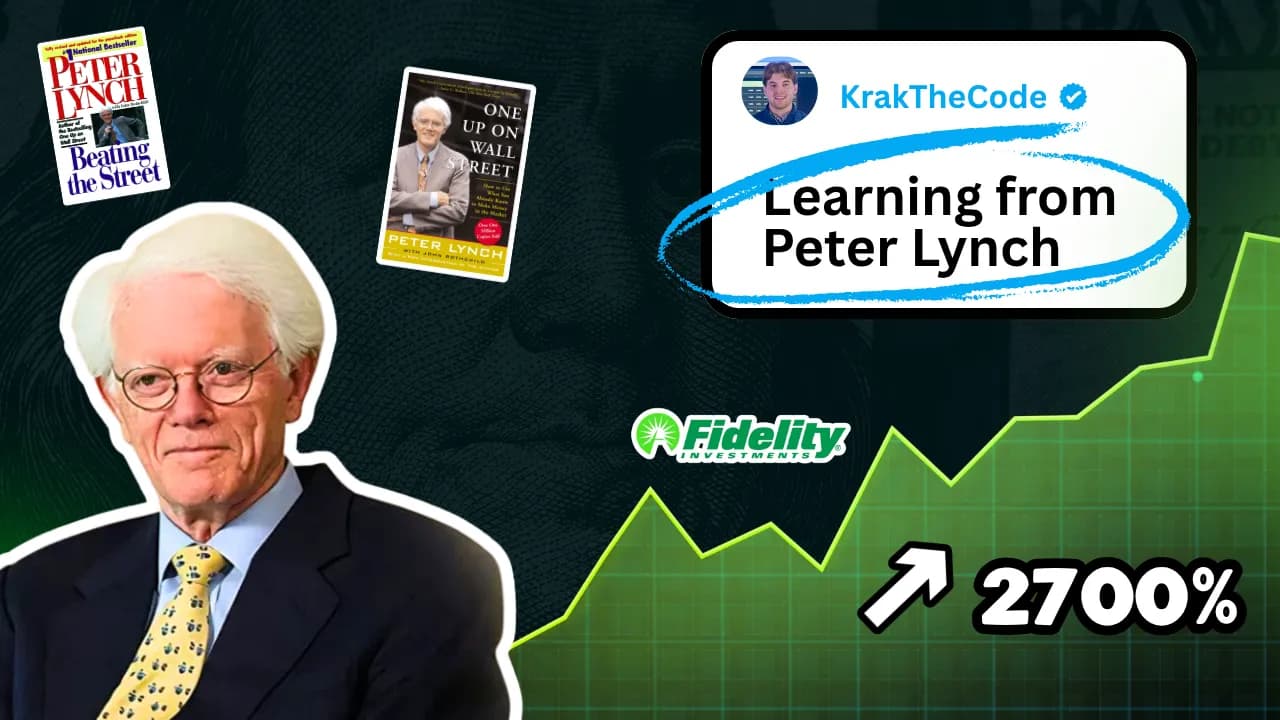
Peter Lynch ran the Fidelity Magellan Fund for 13 years, averaged 29% annually, and beat the market in 11 out of 13 years. Today I want to share with you my biggest takeaways from his timeless insights.
The Story
Peter Lynch did not grow up in finance. He caddied at a golf course outside Boston as a kid, listening to businessmen talk about stocks between holes. He studied history, psychology, and philosophy at Boston College — not finance. He later earned an MBA from Wharton, joined Fidelity as an analyst in 1966, and was handed the keys to the Magellan Fund in 1977. Magellan had $18 million in assets when Lynch took over. When he retired in 1990, it had $14 billion. Over those 13 years he averaged a 29% annual return — outpacing the S&P 500 in 11 of 13 years. A $10,000 investment at the start became roughly $280,000 by the end. The index turned that same $10,000 into about $45,000. The gap is staggering. And then he quit. At the peak. The biggest fund in the world, performing at an elite level, and Lynch walked away at 46. His reason was simple: family vacations had become working trips. He was always on the phone, always visiting companies, never fully present. Something had to give. He chose his family. I find that incredibly admirable, and in retrospect he says he would not have traded the additional time with his wife and kids for any amount of money. He wrote the first two books on investing that I ever read — One Up on Wall Street and Beating the Street — he wrote these so that ordinary investors could learn what he had learned. Practical, plain-English principles that he had stress-tested across thousands of investments. I remember reading each of these books as a Freshman in college, the journey since then has included hundreds of books on business, finance, investing, psychology, history and so much more. That being said, there are certain learnings from Lynch that I will never allow myself to forget. Often times the fundamental knowledge you learn at the beginning is the most important. So thank you in advance for reading, I hope you enjoy Lynch’s timeless lessons as much as I do.
The Lessons
#1 - Invest in What You Know — But Do the Work
Lynch's most famous idea is that individual investors have a genuine edge over Wall Street professionals because they encounter real business activity every day. The restaurant with the line out the door. The product that keeps selling out. The store concept spreading from one city to the next. Professionals sitting in offices processing spreadsheets often miss what is happening on the ground in plain sight. But Lynch was always careful about what this actually means. Noticing a great product is the starting point — not the finish line. You still have to read the balance sheet, understand the debt load, the cash flows, and clearly see the path to how the business will scale. Consumer insight opens the door. Research is what tells you whether to walk through it.
"Know what you own, and know why you own it."
#2 - Ignore the (Broader) Economy. Study the Company.
Lynch had little patience for macro forecasting. The economy is too complex to predict reliably, and the market has likely already priced in whatever the consensus view is. A single company, by contrast, is a manageable thing to understand deeply. You can read its filings, visit its locations, talk to its customers. That is where the edge lives.
"If you spend more than 13 minutes analyzing economic and market forecasts, you've wasted 10 minutes."
This cuts directly against how most investors spend their time today — absorbing Fed commentary, tariff headlines, and recession probability models. Lynch's answer was to tune most of that out and focus on whether the underlying businesses you own are getting stronger or weaker. That is the only question that actually drives long-term returns. Think for example about how many people in the corporate world you know who use Microsoft, Salesforce, ServiceNow, Apple products, Dell or HP laptops. In addition, remember that all you have to do is google their investor relations page and read about how the company has done. That’s what I use the key metrics and 8-pillars for on our software … it gives me the financial snapshot of how the company is performing. Then I simply need to understand if I can pay an attractive price for shares today.
#3 - There Is LITERALLY Always Something to Worry About
In every single year Lynch managed money, there was a compelling reason not to invest. Inflation. Recession fears. Oil shocks. Geopolitical crises. The list was never empty. Hey guys, does that sounds familiar? I have been investing for around six years, it’s been a great six years so far. But think about this, global pandemic, recession fears, tariffs, war, oil crisis, inflation, it never stops. And yet the market recovered from all of it, every time. If I told most people six years ago what the next six years would look like they would have sat on the sideline, but that would have been a huge mistake. The market would have to fall another 60% to get back to pandemic lows. Lynch’s point was not that the risks were imaginary — some of them were very real in the short term. His point was that waiting for certainty before investing is a guaranteed way to miss the compounding that makes equities so powerful over time. The best deals are often when things look worst. The investor who stayed fully invested through every scare of the past 50 years dramatically outperformed the one who stepped aside each time the headlines turned dark. Build conviction in what you own so that the noise loses its power to move you. That’s one of the biggest differences I feel now compared to when I first started, the headlines the macroeconomic events are meaningless to me, my time horizon is decades so the next few months are just an opportunity.
#4 - The Crayon Test (I love this one personally)
If you cannot explain what a company does in 30 seconds using language simple enough to draw with a crayon, you should not own it. Lynch applied this to stocks, index funds, and any financial product someone was trying to sell him. If the explanation required jargon or took more than a minute, something was being hidden — intentionally or not. Think about Meta in 2022, I will give you the simple math that led to me taking a very large position during the massive fall. They produced around $40B in free cash flow, they were spending $10B on reality labs which they could cut with ease if needed. That gives you $50B, which at 20x earnings is a $1T market cap. Meta’s market cap got below $250B. That’s a conservative 4x. Why has Meta done so much better, because they didn’t have flat profit. It grew significantly. Heads I win, tails I don’t lose … which comes from Dhando Investor which I will do a blog on in the future.
#5 - Own Your Mistakes
There’s so many more lessons I want to include but I think the top five make sense for this post. Lynch made bad investments. I have made bad investments. Every serious investor does. What separated him was the discipline he applied afterward. Every failed position had a thesis. When it went wrong, he wanted to know exactly why — was the original analysis flawed, or did something genuinely unpredictable happen? That distinction matters because it teaches different lessons. Flawed analysis is about how you think. Unpredictable events are about how you size positions. I consistently tell community members that my last six years has been an exhibit of failing upwards. I have been wrong on investments and lost money, I have been wrong and made money, I have been right and sold too early … but a reliable process allowed me to do very well. My hope is that I can continue to learn from mistakes over a long investing career and continue to improve each year. Investors who skip this process are condemned to repeat the same errors in new forms. The response to a mistake is more important than the mistake itself. I want to tell you guys a mistake I made around a year into investing. Blindly listening to management. Stanley Black & Decker guided for $2B in cash flow for the upcoming full year at the time. The market cap was $14B or so, I said that’s a strong brand that owns a massive market share at 7x earnings. If it re-rates to even 10-15x which is where it traded historically I would do excellent. But just a few months later, SWK free cash flow went negative. Everything they guided was wrong. I exited at a 25% loss, 5 years later and it is still lower than it was back then. The fundamentals of the business deteriorated, most management teams won’t tell you it’s coming.
The Real Final Lesson
Lynch's decision to retire at 46 is the part of his story that most people skip past. He was at the top of his game, running the most successful fund in the world, and he walked away because the job had consumed his life. He writes about it without drama — just a clear-eyed recognition that the returns were not worth the cost.
That is the lesson underneath all the other lessons. Remember that money is a tool. The point of investing well is not to spend every waking hour doing it — it is to build the financial foundation that lets you live the life you actually want. Lynch built that foundation for millions of Magellan investors and then went home to the family he loved. Which of his lessons hits closest to home for you? Tag me in the community or in the comments and let me know. Thank you for reading, I really enjoy writing these blogs and sharing some learnings I have found important over my journey so far. Looking forward to the next one. - Sam