



The Last Buys: Buffett's Final Moves as Berkshire CEO
A celebration of the greatest investor of all time — and a value-driven look at Chubb, Chevron, and Domino's Pizza.
The End of an Era
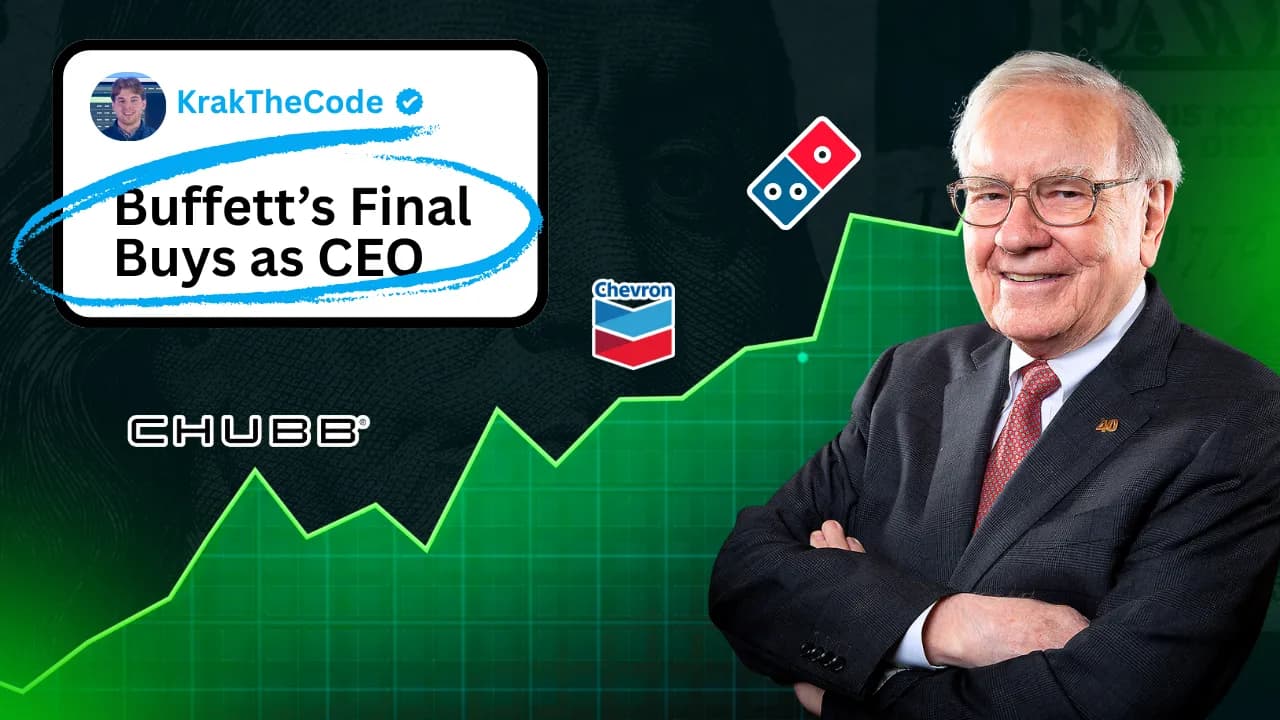
In early 2025 (actually during my college graduation), Warren Buffett announced that he would step down as CEO of Berkshire Hathaway at the end of the year, handing the reins to Greg Abel. After more than six decades at the helm, the Oracle of Omaha is leaving behind arguably the most remarkable investing record in history. It is worth pausing to honor that before we dive into the stocks. Buffett took control of Berkshire Hathaway in 1965 — a dying textile company — and transformed it into a $1 trillion conglomerate. From 1965 through 2024, Berkshire's compounded annual gain in per-share market value was approximately 19.8%, compared to roughly 10.2% for the S&P 500 including dividends. To put that in perspective, $1,000 invested in Berkshire in 1965 grew to over $40 million. The same $1,000 in the S&P 500 would be worth roughly $300,000. What made Buffett different? A few things stand out. First, he was a student of Ben Graham and took the concept of buying businesses at a discount to intrinsic value further than anyone. Second, he never chased trends. He sat out the dot-com bubble, stayed disciplined during the 2008 financial crisis, and deployed capital when others were paralyzed by fear. Third, he had the ability to hold. Buffett did not trade — he owned. He admitted mistakes, celebrated what worked, and always reminded shareholders what mattered: the quality of the underlying business and the price you pay for it. I see it as a fitting to honor his final chapter by looking at the last three buys in Berkshire portfolio with Buffett as CEO: Chubb, Chevron, and Domino's Pizza. So my goal today is do exactly what we talk about all the time, step back and use stock analyzer to see if these decisions make sense.
Buffett's Last Three Buys at a Glance
Chubb (CB) 3.90% of portfolio, Value: $10.7B
Chevron (CVX) 7.24% of portfolio, Value: $19.8B
Domino's Pizza: 0.51% of portfolio, Value: $1.4B
Chubb and Chevron are both significant positions. Domino's is smaller but notable as they’ve added to this one a few times recently. Together these three names say a lot about what Buffett believes the market is mispricing: a dominant insurance carrier, an energy giant, and a beloved consumer brand with a unique franchise model.
Chubb Limited (CB)
Why Buffett Bought Chubb
Chubb is not a glamorous business. It does not make headlines often. What it does is underwrite insurance at a high level of discipline. Berkshire initially built this position quietly and confidentially, receiving a waiver from the SEC to keep the buy hidden for several quarters. That alone tells you how much Buffett wanted to accumulate shares before the market caught wind of it. By the time it was disclosed, Berkshire had amassed over $6 billion in Chubb stock.
Reason #1: Underwriting discipline at scale
Chubb consistently produces strong combined ratios, meaning it makes money on the insurance it writes before even touching investment income. For an insurer, that is the gold standard. Buffett has said for decades that the key to a great insurance business is underwriting discipline, and Chubb is one of the best practitioners of it in the world.
Reason #2: Global reach and pricing power
Chubb operates across more than 54 countries and serves high-net-worth individuals, large corporations, and everything in between. Their ability to charge premium prices in a hard market environment, combined with a diversified book of business, gives them durable earning power.
Reason #3: Float as an investment engine
Like all great insurance businesses, Chubb generates float — the pool of premiums collected before claims are paid. That float is then invested. Buffett has built Berkshire's entire empire on this concept. Chubb's investment portfolio allows them to compound capital at low cost.
My Takeaway on Chubb
This is a classic Buffett buy. A disciplined, high-quality business in an industry he knows better than anyone, purchased at a price that certainly offered a margin of safety. Before this “mystery” position was revealed, Berkshire was loading up at prices below $200 per share. It appears that even at today’s level it is attractive enough for them to continue to raise their stake.
The Right Price for Chubb: Stock Analyzer
For this analysis I used revenue growth rates of 2%, 4%, and 6%, alongside net margins of 15%, 16.5%, and 18%, reflecting Chubb's steady underwriting income and disciplined cost structure. I focused on net income over free cash flow based on the underlying operations of insurance businesses.
The fair value results are as follows:
- Low Price: $289
- Middle Price: $413
- High Price: $584
In Q4 of 2025 shares of Chubb traded below $300 for over a month with lows around $265. If we look at this from the perspective of a company with $385B in cash, I don’t think this addition is surprising at all. Berkshire needs to be able to deploy billions into durable businesses capable of producing strong returns for shareholders. They clearly already understood the Chubb position well, and often times your best opportunity is one in your portfolio to begin with.
Chevron Corporation (CVX)
Why Buffett Bought Chevron
Chevron is one of the largest integrated energy companies in the world and at over 7% of Berkshire's portfolio, it is a significant position. This is not a speculative bet on oil prices — it is a bet on a high-quality, cash-generative business, with long-term product demand, that rewards shareholders through cycles.
Reason #1: Free cash flow machine
Chevron generates tens of billions in free cash flow per year. Even in lower oil price environments the company manages costs. Buffett is attracted to businesses that produce cash flow, not just when conditions are perfect, and Chevron has proven it can do exactly that. I have heard Buffett explain the analogy that the amount of cash flow you receive is the same whether it ranges from $1B to $20B year over year or stays consistent at $10.5B … if you can get the more volatile stream at a discount, it can be a better investment.
Reason #2: Energy is not going away
Regardless of where you stand on the energy transition, the reality is that global energy demand continues to grow. Chevron is investing in both its traditional oil and gas business and in lower-carbon energy solutions. Their primary operations provide the more efficient form of energy and the runway for them is far longer than people likely assume.
My Takeaway on Chevron
Buffett has never tried to predict oil prices, and he is not doing so here. He is buying a world-class operator with a strong balance sheet, decades of consistent dividend growth, and cash flow that would make most businesses envious. The energy sector tends to be out of favor with investors, which may be exactly why Buffett found an opportunity. That is typically how he operates — quietly buying what others are ignoring.
The Right Price for Chevron: Stock Analyzer
For Chevron I used revenue growth rates of 2%, 4%, and 6% to reflect the commodity-sensitive nature of the top line. Profit margins of 8%, 10%, and 12% capture the variance in oil price environments. A PE Ratio of 11-17 was applied given the cyclicality of the sector, but durability of this business.
The fair value results are as follows:
- Low Price: $90
- Middle Price: $147
- High Price: $229
At a current price near $190, Chevron shares don’t appear overly attractive, but here’s a very important note … Berkshire bought heavily in Q4. Shares are up over 25% since then, meaning Buffett was likely buying in the $140-$150 range which looks far more interesting. The current dividend, for those of you who enjoy collecting your income, is just over 3% as I’m writing today.
Domino's Pizza (DPZ)
Why Buffett Bought Domino's
Domino's Pizza has a business model that actually fits Berkshire’s investment style well. You probably look at a company like this and view it as capital intensive, tons of stores, properties … but that’s actually not the case. So let me show you why this one probably interests Buffett.
Reason #1: The franchise model
Domino's does not own most of its stores — its franchisees do. This means Domino's collects royalties and fees on sales without bearing the capital cost of running individual locations. It is an asset-light, high-margin business model that generates strong free cash flow relative to the capital employed.
Reason #2: A durable consumer brand with global scale
Domino's is the world's largest pizza company by global retail sales. They have over 20,000 locations in more than 90 countries. The brand is entrenched. The supply chain is strong. And their technology-first approach to delivery and ordering has given them a moat that pure restaurant competitors cannot easily replicate.
Reason #3: Pricing power and value positioning
In a world where consumers are increasingly price-conscious, Domino's occupies a unique spot — perceived as affordable and convenient. They have also proven they can grow same-store sales through loyalty programs, digital ordering, and menu innovation without sacrificing the core value proposition.
My Takeaway on Domino's
Domino's is a smaller position for Berkshire, but they do not often make mistakes about brand quality. This is a business with a sticky model, recurring demand, and franchise economics that are genuinely excellent. At the right price, it is the kind of business you can hold for a long time and let the earnings compound. It is worth deeper research — especially if it pulls back from current levels.
The Right Price for Domino's: Stock Analyzer
For Domino's I used revenue growth rates of 3%, 5%, and 7%, reflecting steady domestic growth and continued international expansion. Profit margins of 11%, 12%, and 13% reflect the consistency they have shown. A PE of 13-19 was applied at year ten given the brand quality and consistency of earnings.
The fair value results are as follows:
- Low Price: $230
- Middle Price: $325
- High Price: $455
At a recent price near $400, Domino’s doesn’t exactly scream deal, but perhaps you have to be willing to pay a higher premium multiple for this business because of the cash flow consistency. It currently trades around a 20 PE which does not screen as expensive or as cheap, which makes sense.
Focus Areas for CB, CVX, and DPZ Investors
For those of you building a research playbook, here are the key things I track for each of these names heading into future earnings reports. For Chubb, the number one thing I watch is the combined ratio — is underwriting discipline holding up across different business lines and geographies? I also keep an eye on premium growth and whether the hard market environment is sustaining pricing power. Investment income is another lever as rates shift. For Chevron, the key is cost of production per barrel, the resulting profit, and how management allocates it between dividends, buybacks, and capex. I also watch production volumes and whether their cost of supply stays competitive. Any developments on major projects like the Permian Basin and Tengiz expansion are worth monitoring closely. For Domino's, I recommend looking at same-store sales growth both domestically and internationally. Net new store openings tell you about franchisee confidence and brand health. And I always check whether the royalty model is holding — any signs of franchisee stress would be a yellow flag worth investigating.
Final Thoughts
Warren Buffett's final chapter at Berkshire Hathaway deserves nothing but admiration. He took a broken textile business and built one of the most valuable companies on earth —through patient ownership of great businesses at the right prices. That lesson never goes out of style. For anyone who hasn’t gone back and read Berkshire’s decades of shareholder letters, there are so many lessons on investing and I highly recommend it. Now if you have questions, tag me in the community and let's go deeper on all three.

Disclaimer
Everything Money is Not an Investment Advisor: Everything Money (including Paul, Mo, and Any other person including, but not limited to, other staff members, guests, personalities, etc.) is not an investment adviser, and it is not registered as such with the U.S. Securities & Exchange Commission or any other state or federal authority under the Investment Advisers Act of 1940 or any other law. The investments and strategies discussed in Everything Money’s YouTube videos and on Everythingmoney.com are not and should not be considered investment advice and may not be suitable for you. They do not take into account your particular investment objectives, financial situation, needs, or personal circumstances and are not intended to be specific to you. Before acting on any investment or strategy discussed, you should always do your own research and make your own independent decision about whether it is suitable for your particular circumstances. You should also consider seeking advice from your own legal, financial, tax, accounting, or investment advisers. Everything Money does not provide such advice.
READ THE FULL DISCLAIMER HERE: https://everythingmoney.com/disclaimer