




Pabrai Circles The Wagons Around CSU
Mohnish Pabrai's Wagons ETF has taken a 4.80% position in Constellation Software — one of the greatest capital allocation stories ever told. Here is why it matters and what the stock analyzer says about value.
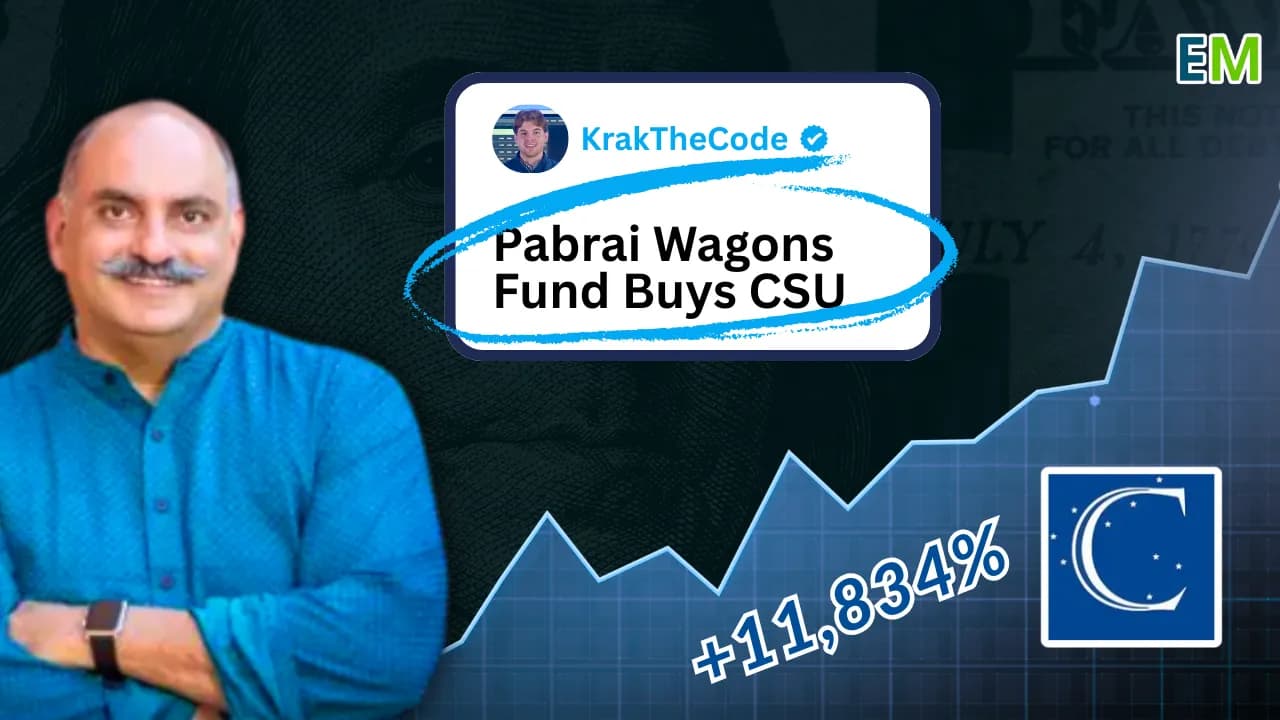
Who is Monish Pabrai?
If you follow value investing seriously, you know the name. Mohnish Pabrai is one of the most respected disciples of Warren Buffett and Charlie Munger alive today. Paul & Mo actually interviewed him years back ... I am insanely jealous in case anyone wonders. He founded Pabrai Investment Funds in 1999 with a structure modeled directly on the original Buffett partnerships — no management fee, a performance-only compensation structure, and a deeply concentrated portfolio of high-conviction bets. Pabrai's record speaks for itself. From 1999 through the mid-2020s, his funds compounded at rates that put him firmly in the top tier of professional investors globally. He reads, thinks, waits, and when he finds something that meets his criteria, he bets with conviction. He is also famous for intellectual honesty. He has written openly about his mistakes, hosted students at lunch, and given away substantial portions of his wealth to charitable causes. Pabrai is a rare combination: a world-class investor who also happens to be a genuine teacher of the craft. His most recent vehicle is the Pabrai Wagons ETF — a publicly accessible fund that brings his investment philosophy to a broader audience for the first time. The name is deliberate. Pabrai circles the wagons around his highest conviction ideas, concentrating capital where he believes the odds are most favorable. He does not diversify for the sake of diversification. He diversifies only when he finds enough ideas that truly meet the bar.
The Pabrai Wagons ETF: How It Works
The Wagons ETF is not a typical fund. Understanding how it is constructed makes the Constellation Software position much more meaningful. Here are the portfolio parameters directly from the fund:
• No more than 25% of total assets will be invested in the securities of a single issuer
• No more than 25% of total assets will be invested in any one industry or group of industries
• With respect to 50% of the fund's assets, no more than 5% in a single issuer, and the fund will not own more than 10% of shares
The position sizing philosophy is equally important. The fund circles the wagons around its highest conviction holdings — the ones Pabrai believes will produce the highest potential investment returns. And critically, the fund generally does not trim winning positions if there has been no change in conviction. When Pabrai buys something, he intends to hold it. As of March 12, 2026, the top ten holdings are as follows:
Edelweiss Financial Services Ltd - 11.95%
Warrior Met Coal Inc - 10.41%
TAV Havalimanlari Holding AS - 9.42%
Valaris Ltd - 6.28%
Transocean Ltd - 5.45%
Alpha Metallurgical Resources Inc - 5.23%
Gimat Magazacilik Sanayi Ve Ticaret AS - 5.09%
Reysas Gayrimenkul Yatirim Ortakligi AS - 5.08%
Constellation Software Inc/Canada - 4.80%
Topicus.com Inc - 4.71%
Two things immediately jump out from this holdings list. First, this is a global portfolio — Turkish airport operators, Indian financial services firms, US offshore drilling companies, and met coal producers alongside a Canadian software giant. Pabrai is hunting in corners of the market that most investors ignore. Second, notice that Constellation Software sits at 4.80% and Topicus.com — a Constellation spinoff — sits directly below it at 4.71%. Together that is 9.51% of the fund in the Constellation ecosystem. That is not a coincidence. Pabrai clearly has deep conviction in how Mark Leonard has built this business and what Topicus represents as it scales independently. We will come back to that.
Constellation Software: The Silent Giant
In 1995, a former venture capitalist named Mark Leonard founded Constellation Software in Toronto with a principle that sounds almost too simple: buy great niche software companies, let them run independently, and never sell. No press tours. No grand product launches. No Silicon Valley bravado. Just a repeatable system applied with extraordinary discipline over three decades. The target was vertical market software — VMS businesses. These are companies that build mission-critical software for specific industries: public transit agencies, dental offices, construction firms, municipal governments, school districts. Unglamorous industries. Essential tools. Deeply embedded in customer workflows. Customers who almost never switch because the cost and disruption of doing so is simply too high.
What made these businesses so attractive:
• High recurring revenue from long-term contracts and subscription models
• Deeply embedded workflows that make switching painful and costly
• Loyal, sticky customer bases with very low churn
• Low capital intensity — software does not require factories or inventory
• Strong free cash flow generation relative to the capital required
• Often undervalued because they were too small, too niche, or not built to be sold
Constellation's acquisition model had strict return hurdles. Every acquisition had to meet internal thresholds for ROIC, payback period, and capital intensity. If a deal did not clear the bar, they walked away. This discipline — saying no far more than yes — is what allowed the model to compound without destroying the return profile through overpriced deals. Here is where Leonard truly broke from every other acquirer in the market. Most roll-up strategies integrate aggressively. They centralize operations, rebrand acquired companies, cut headcount, and extract synergies. Constellation did the opposite.
Every acquired company kept its brand, retained its founding team, operated autonomously, and was responsible for allocating its own capital. Constellation built a decentralized network of over 800 vertical market software businesses grouped into six operating units — all learning from each other through shared knowledge systems, but running independently. The headquarters does not manage the businesses. It teaches them to manage themselves. This matters for two reasons. First, it means Constellation can acquire businesses that would never sell to a traditional strategic buyer who would absorb and homogenize them. Second, it means the model scales in a way that most acquirers cannot replicate. There is no integration bottleneck. The machine just keeps running.
Constellation has compounded its share price at extraordinary rates since going public on the Toronto Stock Exchange in 2006. It has outperformed Google, Amazon, and Microsoft in shareholder returns over the past two decades — without the fanfare, without the debt, and without a single product that most consumers have ever heard of. That is the point. The best businesses are often invisible to the general public. Revenue has grown from roughly $300 million in 2008 to well over $9 billion by 2024. Free cash flow has scaled alongside it. And because the business model is acquisition-driven rather than organic, the key metric to watch is not revenue growth alone but ROIC on deployed capital — and Constellation has maintained extraordinary discipline on that front throughout its history.
The Topicus Connection: 9.51% in The Constellation Ecosystem
It is worth pausing on the fact that Pabrai holds both Constellation Software at 4.80% and Topicus.com at 4.71%. Topicus is not necessarily a separate bet — it is a continuation of a similar thesis. Topicus was spun out of Constellation in 2021 as a separate publicly traded entity focused on vertical market software acquisitions in Europe. It operates with the same playbook Leonard built at Constellation: buy niche VMS businesses, keep them independent, maintain strict return hurdles, and let the capital compound. The key difference is that Topicus is focused on European markets, which are still earlier in the consolidation cycle that Constellation ran through in North America. By holding both, Pabrai is essentially saying: I believe in the model, I believe in the people executing it.
Why Pabrai Bought Constellation Software
Reason #1: The model is genuinely difficult to replicate
Constellation has spent 30 years building relationships with niche software companies, developing internal playbooks for what works, and training a generation of operators in the Constellation way. A new entrant cannot simply copy this by raising a fund and buying VMS businesses. The institutional knowledge, the deal sourcing network, the operator bench, and the cultural DNA are all deeply embedded. That is a durable moat — not a product moat, but an organizational one.
Reason #2: The TAM keeps expanding
One of the most important things Mark Leonard has done in recent years is expand Constellation's definition of what it will acquire. Originally focused tightly on small VMS businesses, Constellation has progressively moved toward larger deals, international markets, and adjacent software categories. The addressable universe of potential acquisitions has grown substantially. And with Topicus handling European expansion independently, the system is running on two tracks simultaneously.
Reason #3: Capital allocation discipline is built into the culture
Pabrai has studied capital allocation his entire career. He knows what great looks like. Constellation's entire identity is built around the idea that deploying capital at high returns is the job. Leonard writes annual letters that are among the most thoughtful shareholder communications in the investing world. The incentive structure, the return hurdles, the decentralized model — all of it is designed to protect ROIC as the business scales. That is rare, and Pabrai recognizes it.
Reason #4: Sticky, recurring revenue insulates against economic cycles
The vertical market software businesses Constellation owns serve customers who cannot easily switch. A transit agency running Constellation's scheduling software is not going to rip it out during a recession. A dental practice using Constellation's billing platform is not going to find a new vendor because margins tighten. This revenue resilience means Constellation can continue acquiring and compounding even during periods of macro stress — which is exactly when valuations on potential acquisition targets become most attractive.
The Right Price for CSU: Stock Analyzer
For this analysis I used revenue growth rates of 8%, 12%, and 16%, alongside free cash flow margins of 18%, 20%, and 22%, reflecting consistently strong growth historically with sound margins. The fair value results are as follows:
- Low Price: $2,826
- Middle Price: $4,936
- High Price: $8,461
Around 9 months ago, shares of CSU were trading over $5,000 per share. Now they have fallen around 50% and hover at the $2,500 level. The margin of safety looks potentially attractive from today’s perspective. This definitely warrants more research and more discussion in the community. If you know a lot about this company, tag me and let’s discuss.
What to Watch as an Investor & Final Thoughts
For those of you adding Constellation to your research notebook, here are the things I would track most closely across quarterly and annual reports. ROIC on acquired businesses is the single most important metric. If Constellation starts overpaying for acquisitions and returns on deployed capital begin to compress, that is the first sign that the model is straining under its own size. Leonard publishes detailed data on this and has been transparent about the challenge. Watch it closely.
Acquisition volume and deal size is the second thing I would monitor. How many deals are they completing per year, and is the average deal size creeping up in a way that changes the risk profile? Larger deals typically mean more competition from private equity and strategic buyers, which drives up prices and reduces returns. Topicus performance as an independent compounder is increasingly important. As Topicus scales its European acquisition strategy, it will tell us a great deal about whether the Constellation model travels across geographies and cultures. Early results have been encouraging.
Finally, keep an eye on free cash flow conversion and how capital is being returned — or not returned — to shareholders. Constellation has historically reinvested almost everything. Any shift in that posture would be a significant signal about management's view of available opportunities. Mohnish Pabrai adding Constellation Software to the Wagons ETF is not a surprise to anyone who has followed his thinking closely. He has spoken admiringly about Mark Leonard's capital allocation philosophy for years. What is notable is that he chose to hold both Constellation and Topicus — effectively doubling down on the model rather than just the stock.
Disclaimer
Everything Money is Not an Investment Advisor: Everything Money (including Paul, Mo, and Any other person including, but not limited to, other staff members, guests, personalities, etc.) is not an investment adviser, and it is not registered as such with the U.S. Securities & Exchange Commission or any other state or federal authority under the Investment Advisers Act of 1940 or any other law. The investments and strategies discussed in Everything Money’s YouTube videos and on Everythingmoney.com are not and should not be considered investment advice and may not be suitable for you. They do not take into account your particular investment objectives, financial situation, needs, or personal circumstances and are not intended to be specific to you. Before acting on any investment or strategy discussed, you should always do your own research and make your own independent decision about whether it is suitable for your particular circumstances. You should also consider seeking advice from your own legal, financial, tax, accounting, or investment advisers. Everything Money does not provide such advice.
READ THE FULL DISCLAIMER HERE: https://everythingmoney.com/disclaimer