


Nick Sleep: The Greatest Investor You've Never Heard Of
921% returns. A fund closed voluntarily at its peak. And a set of investing letters so rare they were once called the Dead Sea Scrolls of finance.
Who Is Nick Sleep?
If you spend enough time in serious investing circles, you eventually hear the name Nick Sleep spoken in the same breath as some of the greatest ever. And then you discover that most people outside those circles have never heard of him at all. That gap between reputation and recognition is part of what makes his story so compelling. Sleep did not study finance. He studied geography at university — a subject he described as a polymath's discipline, reaching into geology, psychology, economics, sociology, and statistics all at once. That unconventional foundation shaped how he thought about everything. He was trained to ask first principles questions, to pull mental models from disciplines that had nothing to do with each other, and to resist the instinct to think inside a single framework.
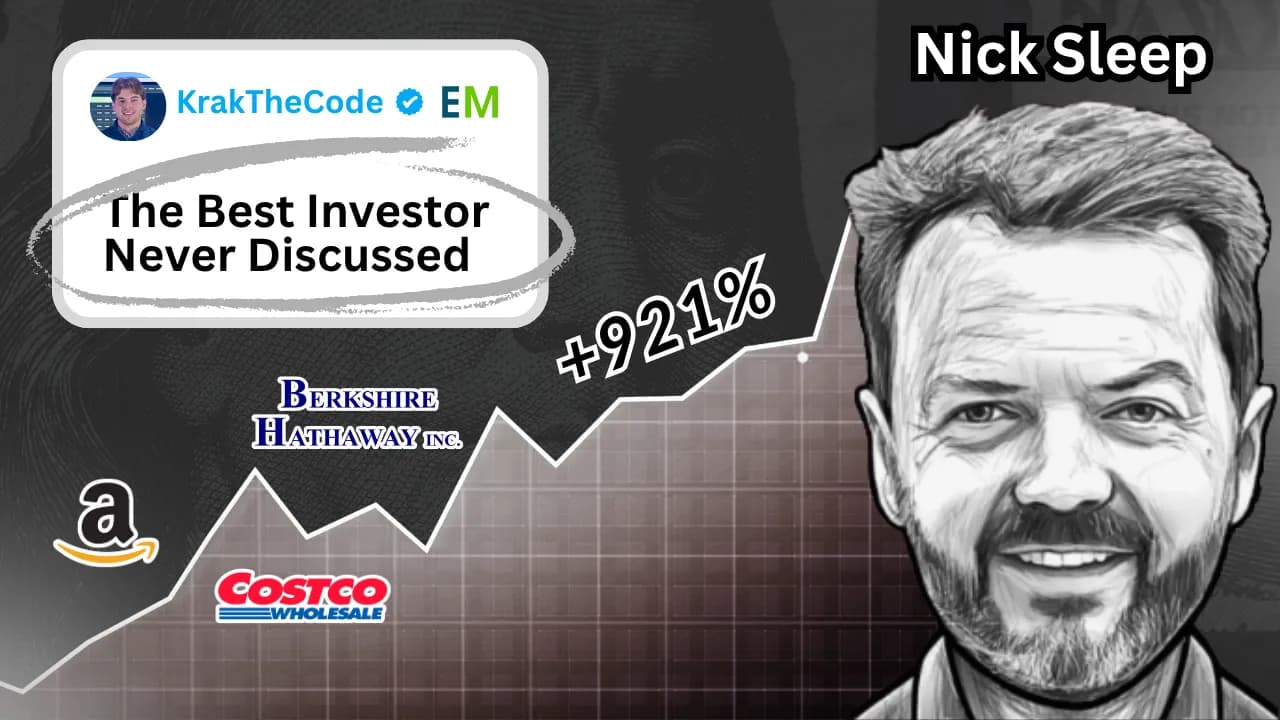
He spent a decade in the investment industry before co-founding the Nomad Investment Partnership in 2001 alongside his partner Qais Zakaria, operating under the umbrella of Marathon Asset Management. The fund was spun out independently in 2006. For thirteen years, from 2001 to 2014, Nomad compounded at 20.8% per year net of fees. The MSCI World index returned 6.5% over the same period. The aggregate result was a 921% return to investors versus 117% for the index. In plain terms: if you put $1 into the index, you ended up with about $2. If you put $1 with Nomad, you ended up with over $10. And then, in 2014, Sleep and Zakaria closed the fund. The reason is one of the most remarkable endings in the history of asset management — and it deserves its own section.
The Dead Sea Scrolls of Investing
During the thirteen years Nomad operated, Sleep and Zakaria wrote detailed shareholder letters documenting not just their investment decisions but their evolving philosophy, their mistakes, their mental models, and their deepest thinking about how great businesses actually work. These letters were never publicly distributed. They circulated quietly among a small community of serious investors, passed from hand to hand like rare manuscripts. For years they were nearly impossible to find. When they finally surfaced publicly in recent years, investors who had spent careers studying the world's best fund managers described them as among the most intellectually honest and analytically rigorous investment documents ever written. One writer called them the Dead Sea Scrolls of finance — everyone knew they existed, but almost no one could find them. Reading the letters cover to cover is thousands of pages of education in business analysis, behavioral psychology, capital allocation, and long-term thinking. I’ve read them, it’s incredible. What follows are the ideas that I believe matter most — the ones that will genuinely change how you look at investing if you take them seriously.
Lesson 1: Think in Decades, Not Quarters
The cornerstone of Sleep's entire philosophy is a time horizon that most investors claim to have and almost none actually practice. He called it destination-oriented investing. His observation was simple and devastating: most investors are obsessed with the smoothness of the journey. They fixate on quarterly earnings, on short-term price movements, on making the ride as comfortable as possible. Sleep argued this was one of the most expensive mistakes an investor could make.
"Traveling comfortably dominates people's thinking when they should be thinking about destinations."
For Nomad, the destination was the compounding of intrinsic business value over years and decades. The when of being right — the precise timing of a stock's appreciation — was far less important than whether you were right in the end. Their average holding period was closer to ten years. Their minimum measurement period for results was five. They held positions through discomfort, through volatility, through quarters that looked bad, because they had done the work on the destination and trusted it. This sounds obvious. Almost every investor says they think long term. But saying it and building a fund structure that actually enforces it — with fee arrangements, partner selection, and psychological discipline all aligned to a decade-long time horizon — is something almost no one in the industry has ever done.
Lesson 2: Scale Economies Shared — The Most Powerful Business Model
Of all the intellectual contributions Nick Sleep made to the investing world, this is the one that will outlast everything else. He identified a specific type of business model that he believed was more durable and more misunderstood than almost any other, and he called it scale economies shared.
Most companies that achieve scale pocket the savings. They grow bigger, their costs per unit fall, and that gap becomes profit margin. That is a rational strategy and it works in the short term. But Sleep identified a different group of companies that do something counterintuitive: they take the savings from scale and give them back to customers in the form of lower prices or better service. And in doing so, they create a flywheel that compounds indefinitely.
"Most companies pursue scale efficiencies, but few share them. It's the sharing that makes the model so powerful. But in the center of the model is a paradox: the company grows through giving more back."
Costco is the clearest example. As Costco grows, it uses its buying power to negotiate lower costs from suppliers. Instead of converting those savings into margin, it passes them directly to members. Lower prices drive loyalty and more purchases. More purchases drive greater volume. Greater volume drives even lower costs. The cycle reinforces itself without end. Sleep measured this with what he called a robustness ratio — how economic benefits were divided between customers and shareholders. At GEICO the ratio was roughly one to one. At Costco it was closer to five to one in the customer's favor. He saw that as a feature, not a bug. Amazon was the other example, and Sleep identified it early — years before the broader market understood what Jeff Bezos was building. Amazon's entire philosophy of reinvesting every dollar of profit back into lower prices, faster delivery, and expanded selection was the scale economies shared model at its purest. Sleep held Amazon through years of zero reported profit and near-universal skepticism because he understood what the destination looked like. The lesson for investors is to look for businesses that are deliberately, structurally generous to their customers. Not as a marketing tactic, but as a core operating philosophy. These companies tend to be misunderstood in the short term — their margins look compressed, their profits look thin — but over time they build moats that are nearly impossible to attack.
Lesson 3: Your Biggest Edge Is Psychological
Sleep was deeply influenced by the investor Bill Miller's framework for competitive advantage. Miller identified three potential edges: informational, knowing something others don't; analytical, drawing better conclusions from available information; and psychological, staying patient and rational when others cannot. Sleep concluded that the first two were fading edges — the internet had democratized information, and analytical talent was increasingly commoditized. The psychological edge was the only one that truly endured. The Nomad letters are filled with case studies in the behavioral traps that destroy investment returns. Social proof — the herding instinct that draws investors toward whatever is already popular — he saw as one of the most destructive forces in markets. The availability bias, where investors overweight the most recent news and lose sight of long-term business reality. Anchoring, where investors justify holding a position based on their original analysis rather than updating as evidence changes. Sleep's investment in Conseco, which ultimately went bankrupt, was his own painful lesson in that last one. He was also a student of Charlie Munger's psychology of human misjudgment, which he described as the finest investment speech ever given — despite never mentioning investments directly. The point was that understanding your own cognitive failures is the prerequisite for thinking clearly about anything else. You cannot analyze a business rationally if your own biases are distorting the inputs.
Lesson 4: Inactivity Is a Strategy
One of the most challenging ideas in the Nomad letters is that doing nothing is often the most valuable thing an investor can do. After identifying a great business at a sensible price, run by honest and capable people, the optimal action is frequently to hold it for as long as possible and resist every impulse to tinker. Sleep ran a highly concentrated portfolio — at times the top ten positions represented 75% of the fund. He was influenced by the Kelly criterion, which suggests that when you have genuine high conviction in an idea, you should size it meaningfully. He saw the massive over-diversification common in the fund industry — portfolios of hundreds of stocks — not as prudence but as an admission that the manager had no real conviction in any single idea.
"The church of diversification, in whose pews the professional fund management industry sits, proposes many holdings. They do this not because managers have so many insights, but so few."
And once the position was built, Nomad's default posture was to hold. Trading creates friction costs, tax drag, and mental churn that compound negatively over time. The real work was done in the research phase. After that, the discipline was to sit with discomfort and trust the destination analysis. Sleep made a point that most investors never fully absorb: the biggest mistake an investor can make is not buying a stock that goes to zero. It is selling a great business too early. The opportunity cost of selling Amazon in 2005, or Costco in 2008, is mathematically larger than the cost of a total loss on an equivalent position. The industry ignores this because opportunity costs do not show up in performance records. Sleep never did.
Lesson 5: Capital Allocation Is Everything — Back Founders
Sleep believed that for a long-term investor, nothing matters more than how a company's management reinvests its profits. A brilliant business can be destroyed by a CEO who makes foolish acquisitions. A mediocre business can become a great investment under a shrewd capital allocator. The compounding of intrinsic value depends almost entirely on what management does with the cash the business generates. He had little patience for companies that issued shares to fund acquisitions or executive compensation, diluting long-term shareholders in ways that rarely showed up in the headline numbers. He admired the rare companies that treated their equity as something sacred — something not to be carelessly distributed but carefully stewarded. Almost 90% of Nomad's portfolio was invested in businesses run by founders or the largest shareholder. Sleep's observation was that the best founders were not primarily motivated by their compensation packages. They were motivated by the challenge, the creativity, the identity of the work itself. Jeff Bezos and Warren Buffett had both substantially waived compensation at various points. The founders Sleep backed derived meaning from building something enduring, not from extracting maximum personal wealth from the enterprise. That alignment of motivation — between what the founder wanted and what a long-term shareholder wanted — was one of the most powerful signals he looked for.
The Most Honest Exit in Fund History
By 2014, Sleep and Zakaria had arrived at a conclusion that most fund managers would find unthinkable. After years of research, compounding, and refinement, they had distilled their entire portfolio down to essentially three positions: Amazon, Berkshire Hathaway, and Costco. These were the compounding machines they believed in most deeply. The logical endpoint of their philosophy was to own them, do nothing, and let the businesses work. Regulators disagreed. Financial authorities informed Sleep and Zakaria that running a fund with that level of concentration and that degree of deliberate inactivity was not permissible. A fund managing outside capital has compliance obligations — minimum diversification standards, trading activity requirements, reporting structures — that exist regardless of how sound the underlying philosophy might be. The regulatory framework was simply not built for an investor whose entire strategy was to own three stocks and never sell them. So they made a decision that no asset manager operating today would seriously contemplate. Rather than compromise the philosophy to satisfy compliance requirements — adding positions they did not believe in, trading when they saw no reason to trade — they returned every dollar to their investors and closed the fund. They refused to dilute what they had built in order to keep managing other people’s money. And then they told their investors exactly what to do with the money. Do what we did. Buy Amazon, Berkshire Hathaway, and Costco. Own them in your personal account. And do not touch them. There is no more honest statement a fund manager has ever made to their investors. No pitch for a successor fund. No reinvention. No fee structure to protect. Just: here is what we believe, here is what we own personally, and here is our parting advice. It is the logical conclusion of everything the Nomad letters argued for thirteen years — that the best investing is simple, patient, and concentrated in the highest quality businesses you can find. Sleep still holds those positions today.
Why Nick Sleep Matters to You Right Now
The ideas in the Nomad letters are more relevant today than they were when Sleep wrote them. The scale economies shared framework describes Amazon, Costco, and a handful of other businesses that have compounded spectacularly over the past two decades — and it describes them more accurately than almost any other analytical lens available. The psychological discipline Sleep preached is more necessary than ever in an environment of instant information, algorithmic trading, and social media markets that move on narrative rather than fundamental value. What Sleep demonstrated above all else is that the edge in investing is not informational. It is not a proprietary model or a data advantage. It is the ability to think clearly about what a business will look like in ten years, to find it at a reasonable price, and then to have the patience and psychological discipline to hold it through everything the market throws at you in the meantime. He thought in decades. He backed founders who built for the long run. He looked for businesses that got stronger by giving more to their customers. And he had the humility to close the fund when he believed the best opportunities were behind him rather than squeezing every last dollar out of a model that had worked. If you have not read the Nomad letters, find them. Read them slowly. Then read them again. Come talk with me in the community about them. They are one of the rarest things in investing — genuinely original thinking, documented honestly, from someone who proved it works. Thank you all for your time.
Disclaimer
Everything Money is Not an Investment Advisor: Everything Money (including Paul, Mo, and Any other person including, but not limited to, other staff members, guests, personalities, etc.) is not an investment adviser, and it is not registered as such with the U.S. Securities & Exchange Commission or any other state or federal authority under the Investment Advisers Act of 1940 or any other law. The investments and strategies discussed in Everything Money’s YouTube videos and on Everythingmoney.com are not and should not be considered investment advice and may not be suitable for you. They do not take into account your particular investment objectives, financial situation, needs, or personal circumstances and are not intended to be specific to you. Before acting on any investment or strategy discussed, you should always do your own research and make your own independent decision about whether it is suitable for your particular circumstances. You should also consider seeking advice from your own legal, financial, tax, accounting, or investment advisers. Everything Money does not provide such advice.
READ THE FULL DISCLAIMER HERE: https://everythingmoney.com/disclaimer