



Michael Burry Is Doubling Down on PayPal and Adobe
The man who called the 2008 housing collapse is adding to two of the market's most hated cash cows. Down 80% and 70% from their highs — is the market wrong, or is Burry?
Burry's Bet: Buying What Everyone Else Has Given Up On
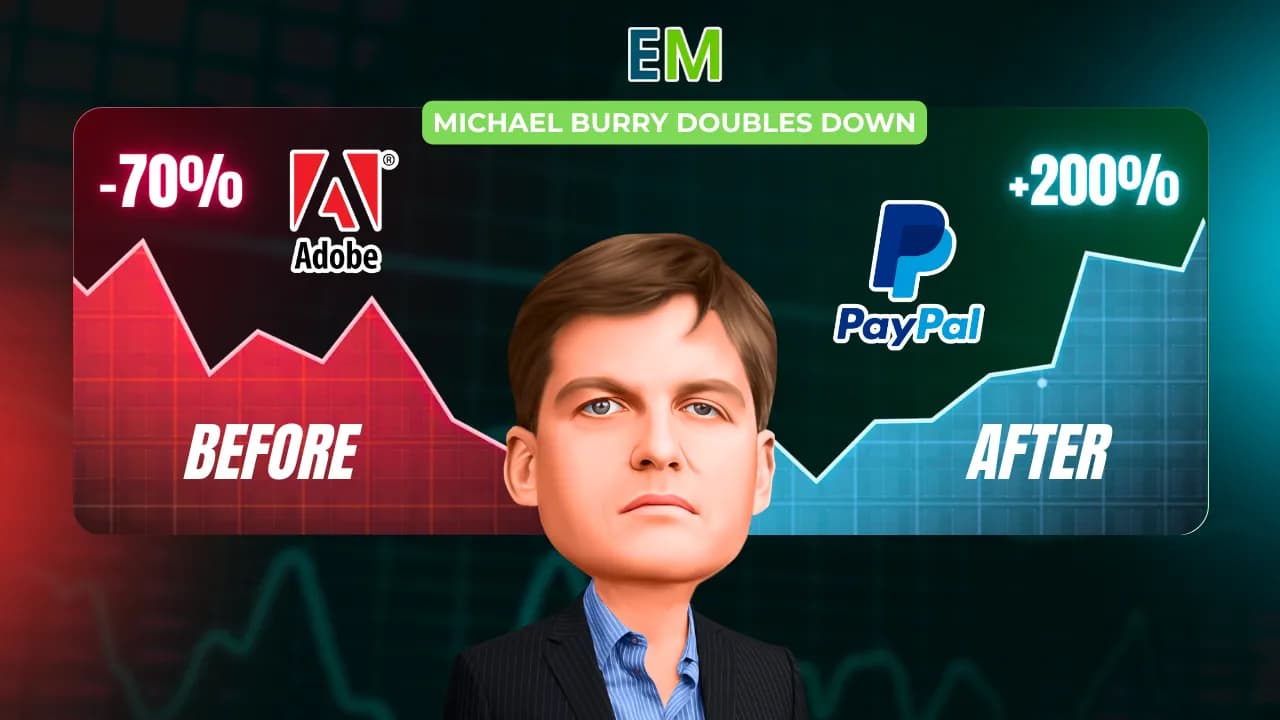
Michael Burry built his reputation by seeing what the crowd could not. In 2008 he identified the subprime mortgage collapse before almost anyone on Wall Street and made a fortune betting against the consensus. His investing style has always been the same: find situations where the market's narrative has diverged so far from the underlying reality that a compelling asymmetric opportunity opens up. He is not interested in what is popular. He is interested in what is mispriced. His most recent 13F filings reveal he has been adding meaningfully to two positions that most of the market has written off entirely — PayPal and Adobe. PayPal is down approximately 80% from its pandemic peak of $399 to around $41. Adobe is down roughly 70% from its high of $690 to around $204. Both stocks have been treated by the market as casualties of the AI disruption narrative. Burry's response is to buy more. He described PayPal as a business the market has been attending the wake for while it buys back stock hand over fist, and called Adobe a clear deep-value opportunity with gross margins near all-time highs. That is worth examining carefully through our Everything Money stock analyzer to see if the results align with Burry's moves.
PayPal (PYPL)
PayPal's fall from grace is one of the more dramatic in recent market history. At its peak the stock traded at over 50 times earnings on the back of explosive pandemic-era growth in digital payments. As growth normalized, competition from Apple Pay, Google Pay, and Venmo alternatives intensified, and the market rerated the stock aggressively — perhaps too aggressively. What the selloff has obscured is that PayPal is still processing hundreds of billions in payment volume annually, generating consistent free cash flow, and buying back stock at a pace that is quietly shrinking the share count. Burry's point about the buybacks is pointed: when a business is buying back its own shares at a price that implies deep undervaluation, management is essentially telling you something the market is ignoring. The ROIC of 12% to 14% is not insanely glamorous but it is stronger than average. The bear case is that PayPal loses relevance as embedded payment options proliferate. The bull case is that a 165 million active account base with deeply embedded merchant relationships does not evaporate — it compounds quietly while the market attends the wake. Running the stock analyzer with revenue growth assumptions of 2%, 4%, and 6%, profit margins of 14.5%, 15.5%, and 16.5%, and a PE of 12 to 18, the fair value range comes out at a low of $67.70, a middle of $94.05, and a high of $129.86 on an earnings basis — and a low of $74.70, middle of $106.19, and high of $149.54 on a discounted cash flow basis, against a current price of $41.53. At current prices the stock is trading well below even the low scenario, implying the market is pricing in significant and permanent deterioration. Burry clearly disagrees. This is either one of the most compelling deep value setups in the market or a value trap. That is exactly the conversation worth having in the community.
Adobe (ADBE)
Adobe is a different kind of story. This is not a broken business — it is one of the finest software franchises ever built, with a near-monopoly position in creative tools and a rapidly growing enterprise document and digital experience business. Photoshop, Illustrator, Premiere Pro, Acrobat, and the broader Creative Cloud suite are used by virtually every designer, filmmaker, marketer, and creative professional on earth. The ROIC has averaged over 27% over the past five years and the free cash flow margin sits near 40%. Gross margins are at or near all-time highs, which is exactly what Burry highlighted. The bear case is AI disruption — tools like Midjourney, Sora, and others are seen as potential threats to Adobe's creative moat, and the failed $20 billion acquisition of Figma, blocked by regulators, created a narrative overhang. But the counter argument is compelling: Adobe has been integrating AI aggressively into its own tools through Adobe Firefly and Sensei, it has the distribution of 30 million creative professionals already on the platform, and it has the enterprise relationships and compliance infrastructure that no AI startup can easily replicate. Burry's read is that the market has dramatically overpriced the disruption risk relative to the actual earnings power of the business. Running the stock analyzer with revenue growth assumptions of 6%, 8%, and 10%, profit margins of 28.5%, 30.5%, and 32.5%, and a PE of 17 to 25, the fair value range comes out at a low of $351.14, a middle of $486.98, and a high of $711.84 on an earnings basis — and a low of $439.69, middle of $602.70, and high of $847.76 on a discounted cash flow basis, against a current price of $204.02. On every scenario the stock is trading at a significant discount to fair value, with the middle earnings scenario implying roughly 140% upside from current levels. That is not a small gap. The question is whether the AI disruption bear case is severe enough to justify it. Burry says no. I would tend to agree that it's overdone.
Final Thoughts
Burry's track record earns him the right to be taken seriously when he goes against the crowd, but it does not make him infallible. He has been wrong before and he will be wrong again. What makes these two positions worth serious research is not just who is buying — it is what the stock analyzer shows when you run the numbers honestly. PayPal is trading well below even a conservative estimate of fair value, implying the market expects permanent and severe deterioration in a business that is still generating significant free cash flow and buying back stock aggressively. Adobe is trading at a fraction of its discounted cash flow fair value for a business with near all-time high gross margins, 40% free cash flow margins, and a moat built over decades of professional adoption. Neither of these is a call to buy blindly. Do your own research, run your own assumptions, and make sure the position fits your portfolio. But when the man who called 2008 doubles down on two businesses the market has given up on — and the stock analyzer confirms they are deeply discounted — it is worth more than a passing glance. Tag me in the community (@KrakTheCode) and let's talk through both.