



Heads I Win, Tails I Don't Lose Much: The Dhando Investor
Mohnish Pabrai distills value investing into its simplest and most powerful form in my personal favorite book: The Dhando Investor. Here is what it teaches about assymetric bets.
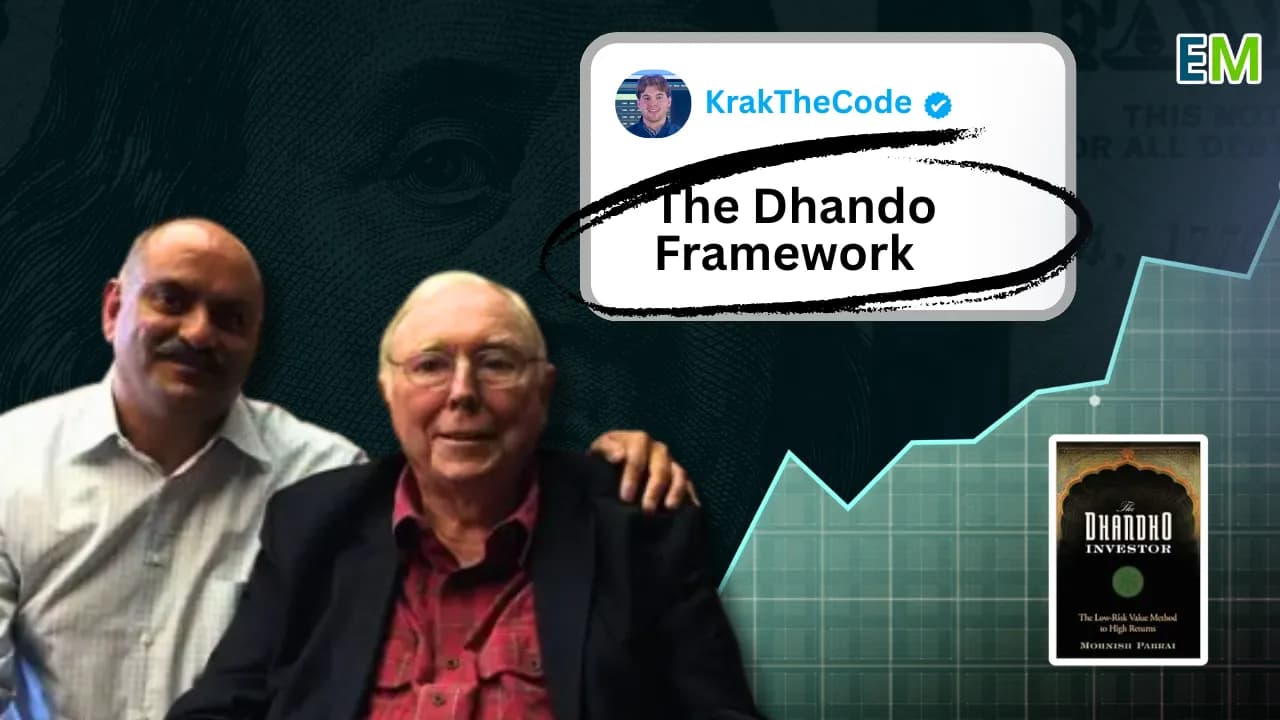
Today we are talking about my personal favorite investing book. The 4th one I ever read, The Dhando Investor has heavily shaped my investment strategy over the past six years and deserves incredible amounts of credit for some of my most successful investments. Here is my breakdown and takeaways of a book I re-read each year, in a simple read you will hopefully enjoy.
What Is Dhandho?
Dhandho is a Gujarati word that translates roughly to endeavors that create wealth. But in Mohnish Pabrai's framework it means something more specific: business and investing conducted with minimal downside and maximum upside. Low risk. High uncertainty. Asymmetric bets. The philosophy is captured in a single phrase that runs through the entire book, one of my absolute phrases you've heard Paul and I use repeatedly in livestreams over recent months: "Heads, I win. Tails, I don't lose much."
Pabrai illustrates it through the story of Papa Patel — a Gujarati immigrant who arrived in America in the early 1970s with almost nothing. He scraped together $5,000, bought a rundown motel with a heavily leveraged loan, and went to work. The downside was losing $5,000. The upside, if the bet paid off even modestly, was a 20-fold return over ten years. If he lost the motel, he and his wife would take jobs, save aggressively, and make the same bet again in two years. The odds of losing twice in a row were 1 in 100. That is Dhandho in its purest form. This is not reckless gambling — but rather structured, asymmetric risk-taking where the worst case is survivable and the best case is transformational. Pabrai argues this is exactly how the greatest investors and entrepreneurs in the world operate, whether they call it that or not.
The Core Lessons
Simplicity Is the Highest Form of Intelligence
Pabrai is relentless on this point. If you cannot write your investment thesis in a short paragraph, something is wrong. If you need to fire up a spreadsheet to justify the purchase, that is a red flag. The best investments are ones where the logic is so clear and the margin of safety so obvious that the case makes itself in plain English.
He quotes Einstein: the five ascending levels of intellect are smart, intelligent, brilliant, genius, and simple. The investor who can reduce a complex situation to its essential logic — and act on it with conviction — has a profound edge over the one building 40-tab models to justify a thesis they do not truly understand.
Buy Distressed Businesses in Distressed Industries
Pabrai is not interested in popular stocks trading at fair value. He wants businesses the market has given up on — companies in beaten-down industries where fear and frustration have pushed prices well below intrinsic value. These situations create the widest gap between price and value, and therefore the largest margin of safety.
The key insight is distinguishing between risk and uncertainty. Wall Street treats uncertainty as risk and prices stocks accordingly. Pabrai sees uncertainty as an opportunity, I believe every investor should. A business facing uncertain near-term outcomes but with a durable underlying model, trading at a deep discount, is exactly the kind of low-risk, high-uncertainty bet that Dhandho is built around.
Few Bets, Big Bets, Infrequent Bets
This is Pabrai's answer to the diversification debate and it echoes what we saw with Nick Sleep and Mohnish's own portfolio. When you find a genuinely compelling idea — one that passes every filter, trades at a massive discount, and has a clear path to value realization — you bet meaningfully. Not everything. But enough to matter.
The result is a concentrated portfolio of well-understood businesses held over years. Most of the time, the gap between price and intrinsic value closes within 3 years. I wrote my senior thesis when I graduated from college on the efficiency of price convergence to value through a case study of investments Berkshire made over the past 25 years. The average period to bridge the gap was approximately 3 years.
The Seven Questions Before You Buy
Pabrai gives investors a pre-purchase checklist that cuts through almost every mistake an investor can make. Before buying any stock, you should be able to answer yes to all seven of these: Is it within my circle of competence? Do I know the intrinsic value today and how it will change over the next few years? Is it priced at more than a 50% discount to intrinsic value? Would I be willing to put a large portion of my net worth into it? Is the downside minimal? Does the business have a durable moat? Is it run by able and honest managers? If any answer is no — or even uncertain — Pabrai says take a pass. There will always be another opportunity. The discipline to say no to almost everything is what makes the yes decisions so powerful. I played college baseball, so the concept that investing is a "no-called strike business" clicked with me the second I heard it. If you don't swing, it does not matter. What matters is your success on pitchers you do swing at.
Know When to Sell
Pabrai's selling framework is as disciplined as his buying framework. Any stock purchased cannot be sold at a loss within two to three years unless you can say with high certainty that the current intrinsic value is below the market price. Sit with the discomfort. Most uncertainty resolves itself within that window. After three years, if the investment is still underwater, it almost always means the original thesis on intrinsic value was wrong. At that point, take the loss, learn from it, and redeploy. The cost of not compounding — of sitting in a dead position indefinitely — is too high. Always be aware of the time value of money. Now here is something to note, I still listen to all of Mohnish's discussions and speeches at different universities. His approach on this has changed a bit, as has mine. He points out that when you end up in the fortunate position of owning a great business at a great price, you do not sell at fair value ... or even moderately overvalued. You only sell once price becomes egregious.
Why This Book Matters
The Dhandho Investor is not a long book and it is not a complicated one. That is the point. Pabrai is showing you that the most powerful investing framework in the world is also the simplest — find great businesses at deep discounts, bet with conviction when the odds are overwhelmingly in your favor, and protect the downside. What makes this philosophy particularly relevant right now is the market environment we are in. Volatility creates distress. Distress creates the exact kinds of opportunities Pabrai describes. The investor who has done the reading, built the framework, and has the patience to wait for the right pitch is in a far better position than the one reacting to every headline. If you have not read this book, pick it up. It is my favorite of hundreds of books I have read in recent years. It is clear and one of the best time investments you will ever make. And if you want to talk through which businesses today fit the Dhandho framework — deeply discounted, durable moat, minimal downside — tag me in the community. That is exactly the conversation worth having right now.
Disclaimer
Everything Money is Not an Investment Advisor: Everything Money (including Paul, Mo, and Any other person including, but not limited to, other staff members, guests, personalities, etc.) is not an investment adviser, and it is not registered as such with the U.S. Securities & Exchange Commission or any other state or federal authority under the Investment Advisers Act of 1940 or any other law. The investments and strategies discussed in Everything Money’s YouTube videos and on Everythingmoney.com are not and should not be considered investment advice and may not be suitable for you. They do not take into account your particular investment objectives, financial situation, needs, or personal circumstances and are not intended to be specific to you. Before acting on any investment or strategy discussed, you should always do your own research and make your own independent decision about whether it is suitable for your particular circumstances. You should also consider seeking advice from your own legal, financial, tax, accounting, or investment advisers. Everything Money does not provide such advice.
READ THE FULL DISCLAIMER HERE: https://everythingmoney.com/disclaimer