



EARNINGS UPDATES: Airbnb, Uber, and MercadoLibre
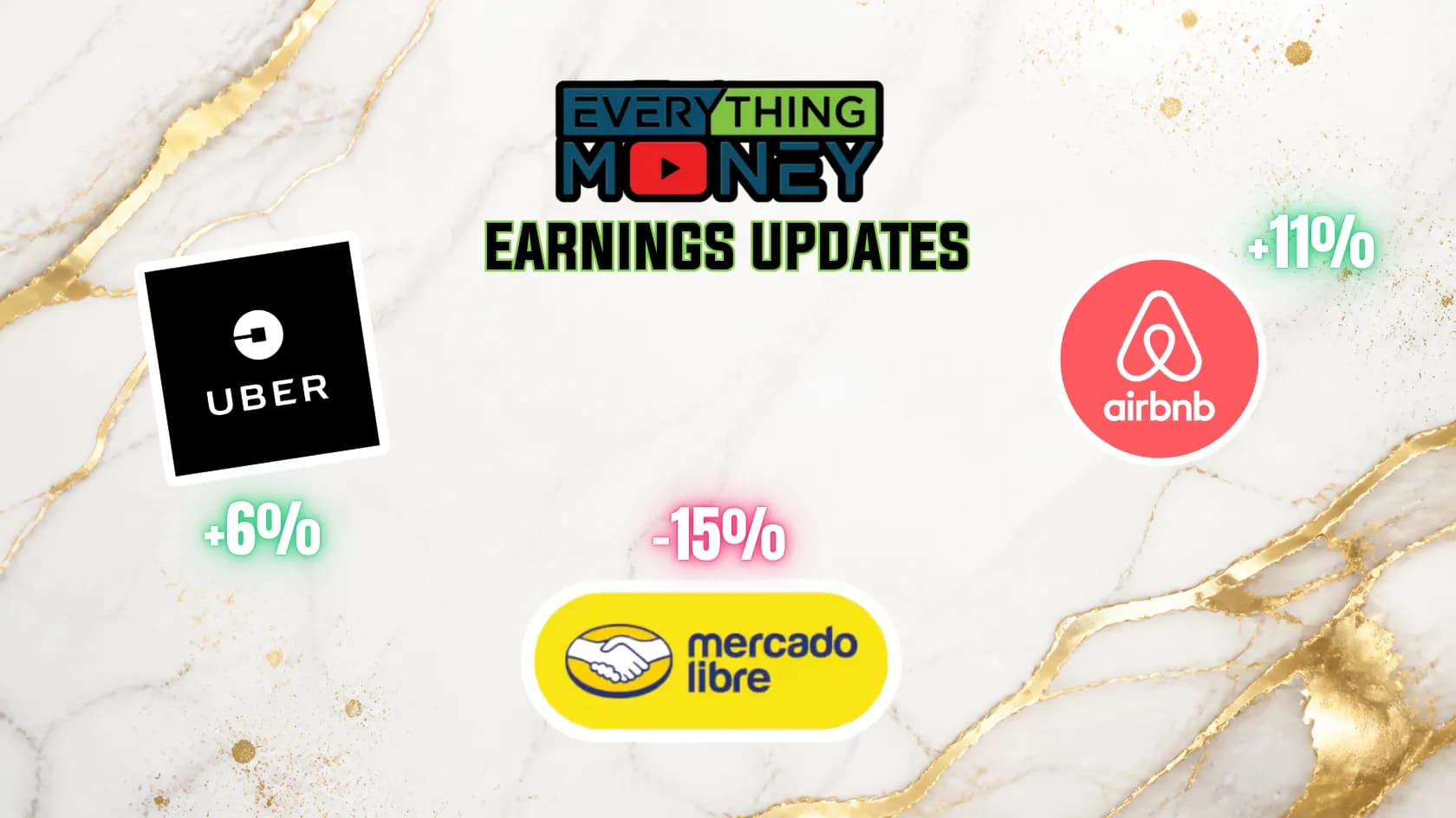
All 3 run technology platforms that connect millions of customers with products or services. Let's check out their most recent earnings, why the stocks fell or skyrocketed, and if the valuation is interesting today.
Airbnb (ABNB): A Marketplace for Travel
What Airbnb does
Airbnb operates an online marketplace where travelers book accommodations offered by property owners and hosts around the world. The company has also expanded into experiences and services. Airbnb generally does not own the properties listed on its platform. It connects travelers with hosts and collects service fees for facilitating bookings.
How Airbnb makes money
Consider a vacation rental booked for $1,000. Most of that money ultimately belongs to the host. Airbnb earns revenue by collecting service fees from hosts, guests, or both, depending on the fee structure.
Here is how the money moves through Airbnb's Q3 2026 income statement. Guests spent $27.7 billion in gross booking value across the platform, and Airbnb earned $4.87 billion of that as revenue. Operating costs and expenses were $2.85 billion, which left operating income of $2.02 billion. Interest and other income added $152 million, and income taxes subtracted $283 million. That produced net income of $1.89 billion.
Airbnb's expenses include payment processing, customer support, marketing, employee compensation, and developing its technology platform. After expenses, taxes, and other financial items, Airbnb earned nearly $1.9 billion in quarterly profit, a 38.8% net profit margin.
Latest earnings: November 5, 2026
Airbnb reported its fastest revenue growth in more than 3 years. Revenue was $4.87 billion, up 19% year over year. Net income was $1.89 billion, up 38%. Gross booking value was $27.7 billion, up 21%, and nights and seats booked rose 16%. Free cash flow was $1.4 billion.
Growth accelerated across every geographic region. In North America, nights booked grew at the fastest pace in 4 years. Management raised its full-year expectations, forecasting revenue growth in the high teens and an adjusted EBITDA margin of approximately 36%.
Revenue grew faster than operating expenses, which helped operating income increase 24%. Lower taxes also contributed to net income growth. Q3 is typically Airbnb's strongest seasonal quarter, so its nearly 39% net margin should not automatically be assumed for the full year.

Uber (UBER): Transportation, Delivery, and Logistics
What Uber does
Uber began by connecting people who needed rides with available drivers. Today it operates 3 main businesses. Mobility covers ridesharing and other transportation. Delivery covers Uber Eats, grocery delivery, and other local deliveries. Freight is technology that connects businesses with transportation providers to move goods. Uber is primarily a platform business. Most rides are completed by independent drivers, and restaurants and other merchants provide the goods sold through its delivery network.
How Uber makes money
Consider a $30 Uber ride. The driver receives an applicable portion of the fare, and Uber earns money through its share of the transaction and related fees. Uber also earns money from delivery fees, merchant commissions, advertising, subscriptions, and freight services.
The total amount customers spend through Uber is not the same as Uber's reported revenue, and accounting treatment varies across services and markets. In Q3 2026, gross bookings were $59.82 billion, and Uber's reported revenue was $14.77 billion. Operating costs and expenses were $13.32 billion, which left operating income of $1.45 billion.
Interest, investment losses, and other items subtracted $592 million, leaving income before taxes and equity-method losses of $855 million. Taxes, equity-method losses, and noncontrolling interests subtracted another $343 million, which produced net income attributable to Uber of $512 million.
Uber's operating expenses include insurance, payment processing, customer support, marketing, engineering, administration, and various incentives. The company generated nearly $1.45 billion in operating profit, but other financial items, including investment-related losses, reduced its final reported earnings.
Latest earnings: November 4, 2026
Uber reported gross bookings of $59.8 billion, up 20%, and revenue of $14.77 billion, up 10%. Trips completed reached 4.1 billion, up 16%, and monthly active consumers reached 215 million, up 14%. Operating income was $1.45 billion, up 30%. Adjusted EBITDA was $2.96 billion, up 31%, and free cash flow was $2.54 billion, up 14%.
Bookings grew twice as fast as reported revenue. Management explained that accounting changes to certain business models reduced reported revenue growth by approximately 8 percentage points.
Uber's reported net income declined sharply from $6.63 billion in Q3 2025. That earlier quarter benefited from a substantial nonrecurring tax adjustment and investment gains. The current quarter included a $476 million pretax loss from revaluing equity investments. For that reason, the 30% growth in operating income is a more useful indicator of the operating business than the headline change in net income. Management expects Q4 gross bookings of $63.25 billion to $65.25 billion.
Uber generated more than $2.5 billion in quarterly free cash flow, compared with its earlier years of heavy operating losses.

MercadoLibre (MELI): Latin America's E-Commerce and Financial Services Platform
What MercadoLibre does
MercadoLibre is often described as the Amazon of Latin America, but its business extends beyond online shopping. It combines 2 major operations. Commerce is an online marketplace where customers buy products from merchants, supported by MercadoLibre's own logistics network and advertising services. Mercado Pago is a digital financial platform that provides payment processing, banking products, credit cards, and consumer and merchant loans.
The combination means MercadoLibre can earn money when customers shop, pay for purchases, advertise products, or borrow money.
How MercadoLibre makes money
Consider a $100 product purchased on MercadoLibre. The company may collect a commission from the seller, earn money from advertising, and charge for logistics services. It also earns revenue when it sells merchandise directly. If the customer pays with Mercado Pago, MercadoLibre may earn payment-related fees. If the customer finances the purchase, MercadoLibre may earn interest while assuming credit risk.
Unlike Airbnb, MercadoLibre earns meaningful revenue both from facilitating transactions and from directly selling products and providing financial services.
Here is how its Q3 2026 quarter breaks down. Commerce revenue was approximately $6.1 billion and fintech revenue was approximately $4.6 billion, for total revenue and financial income of $10.75 billion. Direct costs and financial expenses were $6.37 billion, which left gross profit of $4.38 billion. Operating expenses, including credit-loss provisions, were $3.71 billion, which left operating income of $676 million. Net financial and foreign-currency expenses were $75 million and income taxes were $153 million, which produced net income of $448 million.
MercadoLibre's costs include shipping, warehouse operations, payment processing, marketing, employees, technology development, and provisions for customers who may not repay their loans. The business invests in physical logistics and manages the financial risks of lending.
Latest earnings: November 4, 2026
MercadoLibre reported revenue of $10.75 billion, up 45%. Gross merchandise volume was approximately $23 billion, up 38%, and total payment volume was $109 billion, up 53%. Operating income was $676 million, down approximately 7%, and net income was $448 million, up 6%. The operating margin was 6.3%. The outstanding credit portfolio reached $17.9 billion, up 62%.
Profits grew much more slowly than revenue. Management said it is investing to attract more customers and encourage more frequent purchases. That includes offering free shipping on more products, expanding its warehouse and logistics network, and increasing marketing spending.
In financial services, provisions for potential loan losses increased from $815 million to $1.34 billion as the credit operation expanded. Those investments and expenses reduced operating profitability despite the revenue growth. Whether margins improve as the business scales, and whether credit losses remain manageable, are the items to watch.

Disclaimer
Everything Money is Not an Investment Advisor: Everything Money (including Paul, Mo, and Any other person including, but not limited to, other staff members, guests, personalities, etc.) is not an investment adviser, and it is not registered as such with the U.S. Securities & Exchange Commission or any other state or federal authority under the Investment Advisers Act of 1940 or any other law. The investments and strategies discussed in Everything Money’s YouTube videos and on Everythingmoney.com are not and should not be considered investment advice and may not be suitable for you. They do not take into account your particular investment objectives, financial situation, needs, or personal circumstances and are not intended to be specific to you. Before acting on any investment or strategy discussed, you should always do your own research and make your own independent decision about whether it is suitable for your particular circumstances. You should also consider seeking advice from your own legal, financial, tax, accounting, or investment advisers. Everything Money does not provide such advice.
READ THE FULL DISCLAIMER HERE: https://everythingmoney.com/disclaimer