



Compounders Near 52-Week Lows: Berkshire & Copart
Great businesses rarely go on sale. When they do, it is worth paying attention. Here is a deep dive on two of the best near their lows.
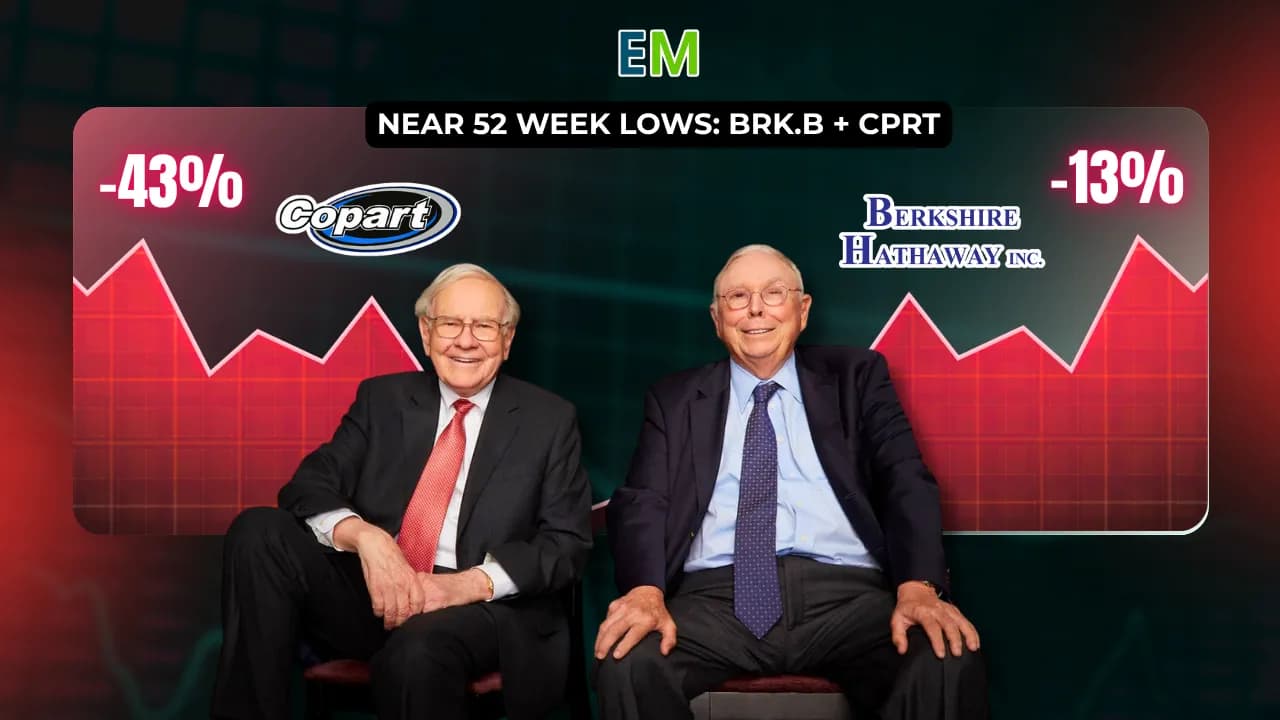
Why 52-Week Lows Matter
Peter Lynch said the person who turns over the most rocks wins the game. Mohnish Pabrai built an entire investing framework around buying businesses at deep discounts to intrinsic value. One of the best places to start looking for opportunities is the 52-week low list. Most investors avoid that list instinctively. A stock near its low feels dangerous. It feels like something is wrong. And sometimes something is wrong. But the more interesting cases are the ones where a genuinely great business has drifted down for reasons that are temporary, sentiment-driven, or simply because the broader market has sold off indiscriminately. Those situations are where real value gets created. That’s exactly why we have both a 52-W Low and Near 52-W Low Screener in our Everything Money software to help members spark new ideas. Berkshire Hathaway and Copart are two of the highest quality businesses in the world and have compounded at high rates for decades. Both are near 52-week lows. Here is why each one deserves serious research right now.
Berkshire Hathaway (BRK.B)
Most people think of Berkshire Hathaway as a stock portfolio. It is much more than that. Berkshire is a diversified holding company that owns some of the best businesses in America outright — GEICO, BNSF Railway, Berkshire Hathaway Energy, See's Candies, Dairy Queen, and so many more. These wholly owned businesses generate massive operating earnings every year regardless of what the stock market does.
On top of that, Berkshire holds a massive equity portfolio — Apple, American Express, Coca-Cola, Bank of America, and others — that compounds alongside the operating businesses. And sitting underneath all of it is one of the largest cash reserves ever accumulated by a single company: over $330 billion as of the most recent filing. That cash earns meaningful interest income in a higher rate environment and gives Berkshire the firepower to act decisively when opportunity finally does strike.
This is a business built to be virtually indestructible. No meaningful debt at the holding company level. Multiple diversified income streams. A management culture built over six decades around rational capital allocation. Warren Buffett's recent transition to Greg Abel as CEO has added uncertainty in some investors' minds — but the system Buffett built is far more durable than any single individual. What I love about Berkshire’s model is that management does not ask how do we hit earnings next quarter, the question is how do we create sustainable value for shareholders over centuries to come.
Stock Analyzer: BRK.B
Valuing Berkshire precisely is notoriously difficult because it is not a traditional operating company — it is a collection of businesses, investments, and cash. The most practical approach is to value the operating businesses on an earnings basis and treat the investment portfolio and cash separately. Do a sum of parts. If we look at stock analyzer, using conservative estimates for revenue growth (3% - 7%) and net margin of 15%, 16%, and 17%. Applying a PE of 14 to 20 on the total income the business can generate, the fair value range for BRK.B comes out approximately as follows: the low scenario lands near $420, the middle near $580, and the high scenario near $800. At a current price near its 52-week low, Berkshire appears to offer a moderate discount to the middle scenario. Another thing to remember is the 1.2x book multiple Buffett once used as a point to buyback shares. Current PB Ratio is 1.42x, which also happens to be the exact median over the past decade. If you want shares at 1.2x book you would add BRK.B to your watchlist at $400 per share.
Copart (CPRT)
Copart is one of the most misunderstood great businesses in the public markets. On the surface it looks simple: the company operates online vehicle auctions, primarily for insurance companies selling totaled cars. In reality it is one of the most defensible, capital-efficient, and globally scalable businesses you will find anywhere.
Here is how it works. When an insurance company totals a vehicle after an accident, it needs to sell that car quickly and efficiently to recover as much value as possible. Copart runs the auction platform — and crucially, it owns or controls the physical storage yards where the vehicles sit until they are sold. Buyers from around the world bid on vehicles through Copart's online platform, driving prices up through global competition. The insurance company gets more money for the totaled car. Copart takes a fee on both sides of the transaction.
What makes this business extraordinary is the combination of physical infrastructure and digital marketplace. Copart owns over 200 storage facilities across North America and internationally. That real estate footprint took decades to build and represents a nearly impossible barrier to entry — you cannot replicate it by writing a check. A competitor would have to acquire land in hundreds of markets, obtain permits, build the yards, and then somehow convince insurance companies to switch away from a platform with superior global buyer reach. The moat is pretty exceptional. I know I was listening to a podcast with Chris Mayer the author of 100 Baggers and he owns CPRT shares. Paul actually interviewed him a few years back as well, great interview if you haven’t watched it yet.
Some investors worry about near-term insurance industry dynamics — if insurers tighten underwriting standards and total fewer vehicles, volume could soften temporarily. There is also general growth stock pressure as higher rates make long-duration earnings less attractive to the market in the short term.
Stock Analyzer: CPRT
For Copart I used revenue growth rates of 4%, 8%, and 12%, reflecting the combination of domestic volume growth, and international expansion. Profit margins of 31%, 33%, and 35% reflect the high-quality marketplace model with operating leverage. A PE of 16 to 24 was applied at year ten given the moat quality, long growth runway, and high ROIC. The fair value range comes out approximately as follows: the low scenario near $25, the middle near $42, and the high scenario near $70.
Final Thoughts
Neither of these is a call to buy blindly. Both require you to do your own research, run your own assumptions through the stock analyzer, and make sure the investment fits your portfolio structure and return objectives. What I will say is this: great businesses at discounted prices are rare. The market does not hand them out often, and when it does, it tends not to leave them there for long. That gap between sentiment and fundamentals is exactly where the opportunity lives. Tag me in the community with your own stock analyzer numbers on both — I want to see where you land and whether the community's intrinsic value agrees with mine.
Disclaimer
Everything Money is Not an Investment Advisor: Everything Money (including Paul, Mo, and Any other person including, but not limited to, other staff members, guests, personalities, etc.) is not an investment adviser, and it is not registered as such with the U.S. Securities & Exchange Commission or any other state or federal authority under the Investment Advisers Act of 1940 or any other law. The investments and strategies discussed in Everything Money’s YouTube videos and on Everythingmoney.com are not and should not be considered investment advice and may not be suitable for you. They do not take into account your particular investment objectives, financial situation, needs, or personal circumstances and are not intended to be specific to you. Before acting on any investment or strategy discussed, you should always do your own research and make your own independent decision about whether it is suitable for your particular circumstances. You should also consider seeking advice from your own legal, financial, tax, accounting, or investment advisers. Everything Money does not provide such advice.
READ THE FULL DISCLAIMER HERE: https://everythingmoney.com/disclaimer