



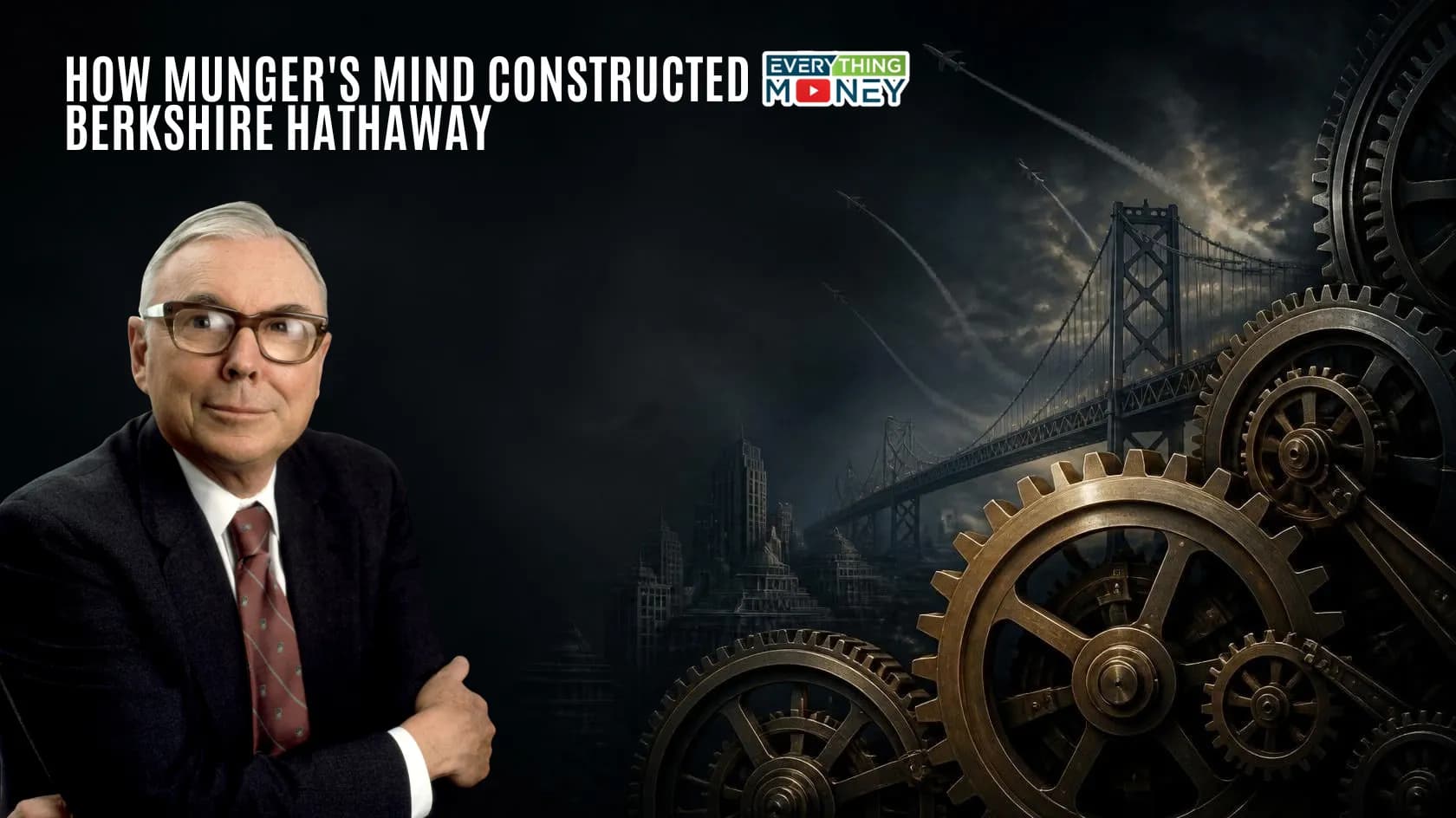
Charlie Munger's Mind: The Mental Models That Built Berkshire
Munger's greatest lesson for us was not some stock-picking formula. It was a better way to think. Here is how he built it — and how you can use it.
The Problem With How Most People Think
Most people learn 1 set of tools and then use those tools on every problem they encounter. An accountant sees the world through financial statements. An economist sees everything through incentives and supply and demand. An engineer solves problems with systems and redundancy. A psychologist looks for behavioral patterns. Each lens contains real insight. Each one, used alone, misses most of the picture.
Charlie Munger spent his life arguing that this is one of the most expensive intellectual mistakes a person can make — and that the solution is surprisingly simple. Learn the most important ideas from the most important disciplines, carry them around in your head at all times, and use several of them simultaneously on every important problem. He called this a latticework of mental models, and he credited it as a primary reason why Berkshire Hathaway produced one of the greatest investment records in history.
"You've got to have models in your head. And you've got to array your experience — both vicarious and direct — on this latticework of models."
Munger estimated that roughly 80 to 90 important models could do about 90% of the work required to develop what he called worldly wisdom. Not 1,000 complicated frameworks. A relatively small number of powerful ideas drawn from mathematics, psychology, economics, engineering, biology, history, and business — used together, not in isolation.
This blog is about the most important of those models and why they matter for investors specifically.
1. Inversion — Solve Problems Backward
Munger loved the mathematician Carl Jacobi's principle: invert, always invert. The idea is to approach problems from the opposite direction. Instead of only asking how to achieve something, ask what would guarantee failure — and then systematically avoid those things.
His most famous application of this was a commencement address where instead of explaining how graduates could guarantee happiness, he described all the ways to guarantee misery and told them to avoid those behaviors. The crowd laughed. The point was serious.
For investors, inversion changes the question. Instead of starting with why a stock might go up, start by asking what could cause you to permanently lose most of your money. Walk through the failure scenarios. Identify the leverage, the cyclical exposure, the covenant risks, the competitive threats, the management incentives that could destroy value. If the stock still looks compelling after that exercise, you have a much stronger basis for owning it.
The reason inversion works is that avoiding large mistakes is often easier than being brilliant. Munger and Buffett did not build Berkshire by finding the next revolutionary technology before everyone else. They built it largely by avoiding the investments that looked seductive but carried hidden risks — and by patiently waiting for the ones where the downside was genuinely limited.
2. Incentives — The Most Underestimated Force in the World
If there is 1 idea that appears more consistently in Munger's work than any other, it is incentives. He summarized it in a single line that is worth memorizing:
"Show me the incentive and I will show you the outcome."
His favorite real-world example involved FedEx. The night-shift package-sorting operation was not working. Workers were paid by the hour, and they were not finishing the work on time. Management tried motivating them in various ways. Nothing worked. Finally someone restructured the compensation so that workers were effectively paid to complete the shift's assignment — and could leave once it was done. The problem largely disappeared. The workers were not lazy or incompetent. The incentives were wrong.
Munger said that despite believing he understood incentives better than most people, he continually discovered he had still underestimated their power. They influence behavior in ways that can overwhelm intelligence, integrity, and even morality.
For investors this is one of the most important analytical filters available. Look at how executives are compensated. If bonuses are tied to short-term earnings per share, management may prioritize buybacks or accounting choices over long-term investment. If salespeople are paid purely on revenue, they may maximize revenue at the expense of profitability or customer quality. If fund managers are paid based on assets under management, they have more incentive to gather assets than to generate returns. You do not need to assume dishonesty. You just need to understand what people are being rewarded to do.
3. Opportunity Cost — Every Decision Has a Competition
Most people evaluate investments in isolation. They ask whether a stock is attractive. Munger argued that the right question is whether it is more attractive than every other use of that capital right now.
If Treasuries yield 5%, a mediocre business growing at 7% is not obviously compelling. If you already own a wonderful business compounding at 15%, deploying capital into something offering 10% might actually be a mistake. Every investment decision is really a comparison between alternatives — and the alternative you decline to take is the true cost of the one you choose.
This mental model explains why Buffett and Munger concentrated capital into a small number of high-conviction positions rather than diversifying broadly. They were not ignoring risk. They were applying opportunity cost. If you genuinely believe your 5 best ideas will outperform your next 50 ideas, spreading capital equally across all 55 is not diversification — it is dilution of your best thinking.
4. Circle of Competence — Know What You Don't Know
Munger believed one of the most valuable things an investor can know is where their own understanding breaks down. The objective is not necessarily to have an enormous circle of competence. It is to know precisely where the edge of that circle is.
A highly intelligent investor who overestimates their knowledge of biotechnology, banking, or emerging technologies can make worse decisions than someone of more modest intelligence who accurately understands what they do and do not know. The dangerous zone is not the area obviously outside your competence — you are unlikely to build a position in something you know nothing about. The dangerous zone is the edge, where things feel familiar enough to generate confidence but are not actually understood deeply enough to support reliable judgments.
For every investment where the analysis requires correctly predicting a drug approval, a cryptocurrency protocol's adoption, or which AI architecture will dominate in 10 years, the honest answer may simply be: too hard. Pass. Munger considered that a completely acceptable and often correct decision.
5. Inversion of Psychology — Understanding Your Own Biases
Munger's most detailed intellectual work was on the systematic mistakes human beings make in their thinking. In a speech titled The Psychology of Human Misjudgment, he eventually organized his observations into 25 psychological tendencies that cause people to behave irrationally — often without realizing it.
A few of the most important for investors:
Social proof is the tendency to copy the behavior of others, especially in uncertain situations. When a stock is going up and everyone around you is getting rich, the psychological pull to participate is enormous. This force has contributed to almost every speculative bubble in history.
Inconsistency-avoidance is the tendency to resist changing previously committed positions. Once you have bought a stock and told people you own it, the psychological cost of reversing course becomes significant — even when the evidence clearly warrants it. Munger saw this as one of the most dangerous tendencies for investors who form strong initial convictions.
Availability misweighing means we put too much weight on information that comes easily to mind. A recent crash dominates an investor's thinking even when long-term base rates tell a different story. A dramatic corporate fraud at one company influences how we evaluate entirely different businesses in unrelated industries.
Contrast misreaction means our perception of something depends heavily on what we compare it to. A stock that fell from $200 to $100 looks cheap — even if $100 is still expensive on any fundamental measure. A mediocre investment looks attractive when it follows 3 terrible ones.
Munger's point was not that these tendencies make people stupid. They are features of human psychology that were useful in other contexts. The investor's job is to learn to recognize them in real time and develop habits that counteract them.
6. Lollapalooza Effects — When Multiple Forces Combine
One of the most sophisticated ideas in Munger's framework is that the biggest outcomes — the speculative bubbles, the catastrophic failures, the extraordinary successes — rarely have a single cause. They emerge when multiple forces act simultaneously and reinforce each other.
Munger called these lollapalooza effects. A financial bubble might combine social proof with envy, overoptimism, authority influence, monetary incentives, and commitment bias all pushing in the same direction at the same time. Analyze any single cause and the phenomenon looks inexplicable. Analyze all of them together and the outcome becomes almost predictable.
The practical lesson for investors is to be especially cautious when you can identify multiple psychological or economic forces all pushing toward the same conclusion. A stock that is going up quickly, that every smart person you know owns, that has a compelling narrative, that just appeared on the cover of a major financial magazine — that convergence of signals is not confirmation. It may be a lollapalooza in the making.
7. Compounding — The Force That Does the Heavy Lifting
Munger viewed compounding as far more than a mathematical function for calculating investment returns. He saw it as the fundamental operating principle behind almost every lasting form of value creation.
Knowledge compounds. A person who learns slightly more than their peers every year for 40 years becomes exponentially more capable, not linearly more capable. Reputation compounds. A business that earns customer trust consistently, year after year, builds a brand that is worth vastly more than the sum of individual transactions. Competitive advantages compound. A business that gets slightly better at serving customers each year while its competitors stay the same eventually achieves a position that feels impossible to challenge.
Munger described the most successful people he knew as learning machines — people who were committed to becoming slightly wiser every single day, not through dramatic insights but through consistent accumulation. At the end of a long life, the difference between that approach and intellectual stagnation is staggering.
For investors the compounding lesson is that the greatest risk is often not a single bad year but the interruption of a long-term compounding process. Avoiding permanent capital loss — the kind of loss that removes you from the table entirely — matters more than capturing every short-term gain.
See's Candies: All the Mental Models Working Together
The most useful way to see how Munger's latticework actually functions in practice is through the See's Candies investment.
In 1972, Buffett and Munger's Blue Chip Stamps bought See's Candies for $25 million. The company had roughly $30 million in sales and less than $5 million in pretax earnings. By Benjamin Graham's traditional standards — buy statistically cheap assets — this was not an obvious bargain. But Munger pushed for the purchase because he recognized something the numbers alone did not show.
See's had extraordinary pricing power. Californians associated See's chocolate with love, tradition, and gift-giving in a way that had been built over decades. The brand was deeply embedded in how people thought about special occasions. That meant See's could raise prices modestly every year and customers would keep buying — not because they had no choice, but because See's had become part of how they expressed affection. No competitor could easily replicate that association regardless of how good their chocolate was.
By 2014, See's had generated approximately $1.9 billion in cumulative pretax earnings while requiring only about $40 million of additional capital investment over more than 4 decades. The original $25 million purchase had produced cash that Berkshire could redeploy into other investments at attractive returns — essentially compounding the original investment through multiple generations of businesses.
Notice how many mental models the See's analysis requires simultaneously. The moat analysis explains the pricing power. The incentives framework explains why franchises without that pricing power would eventually be competed away. The compounding model explains why a business requiring almost no reinvestment is worth more than it appears. Inversion asks what could destroy the competitive advantage. Opportunity cost asks whether the $25 million was better deployed here than anywhere else. Circle of competence asks whether the buyers genuinely understood the candy business. No single lens gets you to the conclusion. The latticework does.
The Deepest Lesson: Avoid Stupidity Before Seeking Brilliance
Perhaps the most counterintuitive theme in everything Munger wrote and said is that extraordinary long-term results come more from avoiding predictable mistakes than from making brilliant decisions.
Investment culture celebrates prediction. Finding the next great company before anyone else. Calling the market top. Identifying the disruptive technology. Munger's philosophy was more defensive and, in his view, more honest about the actual limits of human foresight.
His checklist of things to systematically avoid included: businesses you genuinely do not understand, excessive leverage, dishonest management, terrible incentive structures, absurd prices, decisions made under strong emotional pressure, following crowds without independent analysis, and any position whose survival requires everything to go right.
That is inversion applied to the entire investing process. Instead of asking what makes a great investment, ask what makes a catastrophic one — and then eliminate those scenarios from consideration. What remains is a much smaller universe of opportunities, but a much higher quality one.
Munger never claimed this approach was easy. He acknowledged that the psychological pull toward action, toward following the crowd, toward defending previous positions, is powerful and persistent. The framework is not a formula that removes difficulty. It is a set of habits that, practiced consistently over time, produce substantially better decisions on average — which, through the force of compounding, produce extraordinary results over a long investing life.
That is the Munger system. Not a list of hacks. Not a collection of clever sayings. A genuine attempt to build a better way of thinking — and the patience to apply it for decades. Tag me in the community and let's talk about which of these models you find most useful in how you evaluate stocks today.
Disclaimer
Everything Money is Not an Investment Advisor: Everything Money (including Paul, Mo, and Any other person including, but not limited to, other staff members, guests, personalities, etc.) is not an investment adviser, and it is not registered as such with the U.S. Securities & Exchange Commission or any other state or federal authority under the Investment Advisers Act of 1940 or any other law. The investments and strategies discussed in Everything Money’s YouTube videos and on Everythingmoney.com are not and should not be considered investment advice and may not be suitable for you. They do not take into account your particular investment objectives, financial situation, needs, or personal circumstances and are not intended to be specific to you. Before acting on any investment or strategy discussed, you should always do your own research and make your own independent decision about whether it is suitable for your particular circumstances. You should also consider seeking advice from your own legal, financial, tax, accounting, or investment advisers. Everything Money does not provide such advice.
READ THE FULL DISCLAIMER HERE: https://everythingmoney.com/disclaimer