



Bill Ackman Carved These 8 Investing Rules Into Stone
The Eight Commandments of Pershing Square are not a simply a checklist for finding great companies. They are a system designed to prevent them from owning a bad one as well.
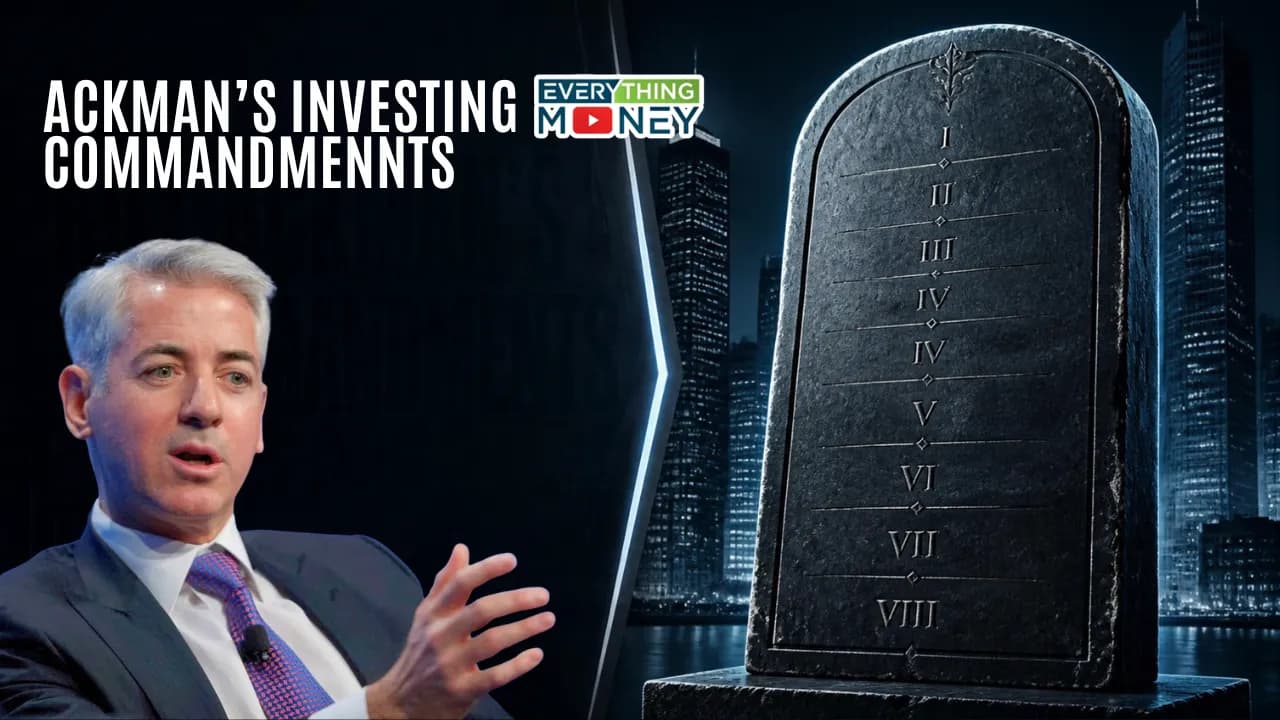
The Granite Tablet
At some point after the worst period of his career, Bill Ackman told a member of his team to find a large piece of granite and a chisel. He wanted Pershing Square's core investment principles treated the way Moses treated the Ten Commandments — carved into stone, impossible to casually revise, sitting on every desk and in every conference room in the office. Then he added the instruction that followed:
"If we ever again veer from the core principles, hit me with a baseball bat."
That sentence captures something important about what the Eight Commandments actually are. They are not a sophisticated analytical framework. Every serious investor already knows that predictable businesses with strong competitive positions and conservative balance sheets are preferable to unpredictable ones with fragile finances. Ackman knew this too. He had written versions of these principles in Pershing Square reports as early as 2014 and 2015 — years before the investment that made the granite necessary.
The principles became commandments because Ackman learned that knowing the rules is not the same as following them. After losing approximately $4 billion on Valeant Pharmaceuticals, he realized that intelligence can be the enemy of discipline. A brilliant investor can construct more sophisticated arguments for why this particular situation deserves an exception. The tablet exists to put the rules above the argument — and, perhaps most importantly, above the founder.
The $4 Billion Lesson: Valeant
Valeant Pharmaceuticals did not violate one of Ackman's principles. It violated most of them simultaneously, and the fact that Pershing owned it anyway is precisely the point.
Start with predictability. Ackman's framework demands businesses whose future cash flows can be estimated with reasonable confidence years into the future. Pharmaceuticals involve drug discovery, patent cliffs, regulatory approval, pricing battles, and reimbursement complexity. That is essentially the opposite of a coffee subscription, a railroad freight contract, or a music royalty stream. The future earnings of a pharmaceutical company are, by nature, difficult to handicap.
Then there is what Ackman later called the confidence-sensitive financing problem. Valeant's growth strategy depended on acquiring other pharmaceutical businesses, often using its own elevated stock price as acquisition currency. When investors lost confidence, the stock fell. When the stock fell, the acquisition model broke. When the model broke, the stock fell further. The business required external capital markets to keep believing in the business — a reflexive loop that the commandments now specifically prohibit. Ackman's retrospective description was simple:
"We made an investment in a business that didn't meet our core principles."
The critical insight is not that Ackman failed to identify these problems. It is that he identified them, constructed compelling arguments for why they were manageable in this particular case, and proceeded anyway. Valeant did not teach Pershing Square what the rules should be. It taught them that rules you are willing to bend are not really rules at all.
The Eight Commandments Explained
Pershing Square's current framework lists 8 core investment principles. Understanding what each one actually demands — and why — is more useful than simply memorizing the list.
Simple and predictable. This is the foundational requirement from which almost everything else follows. Ackman has explained it through basic valuation logic: the value of any financial asset is the present value of the cash it will produce over its life. If you cannot reasonably estimate those future cash flows, you cannot calculate intrinsic value with any meaningful confidence. Simple does not mean unsophisticated — Google Search and Universal Music involve enormous complexity. What Ackman wants is an economically understandable machine. You should be able to explain why customers buy, why they will keep buying, and roughly what the economics will look like a decade from now.
Free-cash-flow generative. A company can report growing revenue, EBITDA, or accounting earnings while continuously consuming outside capital to remain competitive. Ackman's framework cares about cash that can ultimately belong to owners — what is left after maintaining the competitive position of the business. This is the economic reality beneath the accounting presentation, and it is what determines whether growth creates shareholder value or merely makes the company larger.
Formidable barriers to entry. A great business without a moat is often only temporarily great. Pershing Square's 2015 principles described the sources it valued most: brands, unique assets, long-term contracts, and dominant market positions. The more sophisticated version of this commandment is a second-order question — if the economics are so attractive, why can't someone take them away? The answer to that question determines whether the advantage is durable or fragile.
Limited exposure to extrinsic factors. This one deserves more attention than it usually receives. Ackman is not predicting that the future will be calm. He is building in the assumption that it will not be. Pershing's materials describe seeking businesses whose competitive advantages allow them to succeed despite negative extrinsic factors that inevitably emerge. The rule is not: predict the storm. It is: own businesses that do not require you to predict it. Drug pricing regulation, interest rate cycles, commodity prices, and geopolitical shifts are all forces that can overwhelm even excellent management teams. Ackman's preference is to sidestep them as much as possible.
Strong financial profile and minimal capital-markets dependency. These are 2 related but distinct ideas. A company can appear solvent on leverage ratios while still depending on continuous refinancing, equity issuance, or acquisition currency to execute its strategy. The more useful test Ackman has applied is something like: if the stock exchange and bond market closed for 3 years, would this business be merely inconvenienced or genuinely endangered? Valeant would have been endangered. The ideal Pershing company would barely notice.
Attractive valuation. Ackman is not saying buy any great business at any price. His current framework explicitly requires a fair price for the company as it exists today, with a substantial discount to the value it could achieve under optimal conditions — without requiring speculative future events to justify the base case. This reflects the evolution of his thinking: quality is the starting point, but price determines your return.
Large market capitalization. This is perhaps the most institutional-sounding of the 8. For a concentrated fund running significant capital, liquidity matters. Pershing needs to be able to build and exit positions without moving the market against itself. Large-cap investments also provide better data, analyst coverage, and governance standards. This commandment is as much about Pershing's structure as about business quality.
Exceptional management and governance. Ackman's view here is more nuanced than simply find a great CEO. Integrity, track record, appropriate incentives, and governance structure all matter. His career provides 2 instructive case studies in opposite directions. At Canadian Pacific, Ackman identified a fundamentally excellent railroad being operated below its potential and brought in Hunter Harrison, one of the greatest railroad operators of his era. The stock including dividends rose 244% from Pershing's average cost to the final sale. At J.C. Penney, Ackman helped recruit Ron Johnson — a genuinely accomplished executive who had succeeded brilliantly at Apple and Target — and the transformation failed spectacularly. The lesson is that the best résumé does not automatically mean the right manager for a specific business, customer base, culture, and moment in time.
Why Concentration Makes These Rules Mandatory
The Eight Commandments cannot be understood separately from how Pershing Square is constructed. The fund typically holds 8 to 12 core positions, adding only 1 to 3 new investments per year. At that level of concentration, being seriously wrong about a single business does not create a manageable drag on performance — it can define a year or an era.
Conventional portfolio theory addresses uncertainty through diversification. Own enough positions and no single mistake can be catastrophic. Ackman addresses uncertainty a different way: by rejecting most businesses before they enter the portfolio. The commandments are what make extreme concentration intellectually defensible. If you are going to hold 10 positions, each one has to be able to absorb the unexpected. That means predictable cash flows, real competitive advantages, conservative financing, and management that will not make the situation worse when things get difficult.
This also explains Pershing's characteristically low turnover. Ackman has written that frenetic investment activity is often the enemy of long-term performance. That is not a philosophical preference for patience — it is the mathematical consequence of having very high admission standards. When a business genuinely meets all of the commandments and the price is attractive, the default response is to hold it rather than trade around it. The fund added only Alphabet and exited only Lowe's in all of 2023.
The Proof That Something Changed: Netflix
Anyone can write principles after a catastrophic loss. The more interesting question is whether they actually constrain future behavior — or whether they become polished marketing material that is quietly set aside when a compelling opportunity arrives.
Netflix may be the strongest evidence that something genuinely changed. Pershing bought the shares in January 2022, believing Netflix possessed many of the characteristics it valued: subscriber scale, recurring revenue, a content moat, improving free cash flow, and long-term global growth potential. Within months, management announced changes — including advertising and increased monetization of non-paying households — that made the long-term subscriber growth trajectory, margins, and capital intensity harder to predict.
Ackman sold. Pershing lost several hundred million dollars and acknowledged the mistake. But the letter explaining the exit said something more important:
"We require a high degree of predictability in the businesses in which we invest…"
He did not say Netflix was a bad company. He did not argue the price had become attractive enough to compensate for the uncertainty. He said the dispersion of possible outcomes had become too wide for a concentrated core holding — and he left.
Compare that to Valeant: as complexity increased, Pershing became more deeply involved, eventually joining the board to attempt repairs. With Netflix: as uncertainty increased, Pershing exited. That is not the same investor. That is the granite tablet working exactly as designed.
What Passing the Test Looks Like: Universal Music
If Valeant is the anti-commandment, Universal Music Group is the positive case study. When Ackman announced the UMG investment in 2021, he said explicitly that it met all of Pershing Square's acquisition criteria and investment principles.
Work through each commandment and UMG checks them almost perfectly. The streaming-royalty revenue model is highly predictable — when a song is played, UMG gets paid, and global music consumption has grown steadily for decades. The economics are capital-light, generating substantial free cash flow without requiring continuous heavy reinvestment. UMG holds the dominant global position in recorded music, with an irreplaceable catalog of artists and IP that no competitor can replicate regardless of capital. The barriers arise from both the historical catalog — which cannot be rebuilt — and the artist relationships that determine who controls new music. The balance sheet was conservative, with net debt below 1 times EBITDA at announcement. And Ackman expressed confidence in Lucian Grainge and the management team.
UMG illustrates that the commandments are not merely a system for avoiding disasters. Applied rigorously, they also identify the businesses worth owning for decades — companies where a long holding period compounds the original insight rather than gradually eroding it.
The Real Lesson
Bill Ackman's Eight Commandments are not a discovery. The underlying ideas — own predictable businesses with durable moats, conservative financing, and excellent management, purchased at sensible prices — have been articulated by thoughtful investors for generations. What makes Pershing Square's framework distinctive is not its content but its purpose.
The commandments exist because Ackman learned that he was capable of violating his own principles when sufficiently convinced that the situation warranted an exception. Valeant was not a failure of analysis. It was a failure of discipline disguised as sophisticated analysis. The investment thesis became a mechanism for explaining away the very rules that existed to protect against it.
Every investor eventually faces a moment where a compelling story and a reasonable price combine to make an exception feel justified. The question worth asking — and one worth asking about your own process — is what you have built to protect against yourself in that moment. For Ackman, the answer is a piece of granite sitting on the desk. Tag me in the community and let's talk about which of these principles you find most useful in how you evaluate your own portfolio today.
Disclaimer
Everything Money is Not an Investment Advisor: Everything Money (including Paul, Mo, and Any other person including, but not limited to, other staff members, guests, personalities, etc.) is not an investment adviser, and it is not registered as such with the U.S. Securities & Exchange Commission or any other state or federal authority under the Investment Advisers Act of 1940 or any other law. The investments and strategies discussed in Everything Money’s YouTube videos and on Everythingmoney.com are not and should not be considered investment advice and may not be suitable for you. They do not take into account your particular investment objectives, financial situation, needs, or personal circumstances and are not intended to be specific to you. Before acting on any investment or strategy discussed, you should always do your own research and make your own independent decision about whether it is suitable for your particular circumstances. You should also consider seeking advice from your own legal, financial, tax, accounting, or investment advisers. Everything Money does not provide such advice.
READ THE FULL DISCLAIMER HERE: https://everythingmoney.com/disclaimer